
Oman is quietly becoming one of the most active IoT deployment markets in the Middle East. Driven by a combination of ambitious national transformation targets, a maturing industrial base, and growing regulatory pressure on environmental compliance and energy efficiency, organizations across the Sultanate are investing in connected monitoring infrastructure at a pace that would have seemed unlikely five years ago. For technology decision-makers evaluating IoT solutions Oman has become a market where early deployment is no longer a competitive advantage; but it is rapidly becoming an operational and compliance baseline.
This article examines the key industries driving IoT adoption in Oman, the regulatory and economic forces shaping deployment decisions, and the specific monitoring applications gaining the most traction across the Sultanate’s industrial and commercial sectors.
Why Oman Is Accelerating IoT Adoption

The context for IoT growth in Oman is inseparable from Oman Vision 2040, the national development framework that sets out a comprehensive economic diversification agenda moving the Sultanate away from hydrocarbon dependence. Two pillars of Vision 2040 are directly accelerating IoT solutions deployment:
Economic diversification is driving investment in manufacturing, logistics, tourism, and technology sectors, all of which require the kind of operational infrastructure that IoT monitoring provides. New industrial zones at Sohar, Duqm, and Salalah are attracting foreign and domestic investment into facilities that are being built to international operational standards from the ground up, creating natural demand for environmental monitoring, energy management, and network infrastructure systems.
Sustainability and environmental compliance commitments under Vision 2040 and Oman’s National Energy Strategy require measurable reductions in energy consumption and carbon emissions across industrial and commercial operations. The Ministry of Environment and Climate Affairs (MECA) has progressively tightened environmental reporting requirements for industrial operators and since January 2025, the Muscat Stock Exchange has mandated sustainability reporting for all listed companies against 30 GRI-aligned metrics. For organizations in Oman’s industrial zones, smart facility management through IoT monitoring is now the practical mechanism for meeting these obligations.
Key Industries Deploying IoT Solutions in Oman
Oil, Gas, and Energy
The hydrocarbon sector remains Oman’s largest industrial employer and continues to be the most active early adopter of industrial IoT solutions in the Sultanate. PDO (Petroleum Development Oman), OQ, and their supply chain partners have been deploying connected monitoring infrastructure across upstream and downstream operations for years like tracking environmental conditions, equipment health, and energy consumption at remote sites where manual monitoring is impractical.
The shift toward renewable energy, Oman has committed to generating 30% of its electricity from renewables by 2030, which is creating new IoT deployment demand for solar farm monitoring, where dust accumulation on panels, ambient temperature, and irradiance data directly affect generation performance and maintenance scheduling.
Logistics and Cold Chain
Oman’s strategic location at the intersection of Gulf, Indian Ocean, and African trade routes makes logistics one of the fastest-growing sectors in the Sultanate. The Port of Sohar, Muscat’s logistics parks, and the emerging Duqm port complex are all expanding their cold chain and temperature-sensitive storage infrastructure that creates direct demand for IoT solutions Oman logistics operators can deploy to monitor and document cold chain integrity across their facilities and transport operations.
Pharmaceutical importers, food distributors, and FMCG companies operating through Oman’s distribution network are facing increasingly specific cold chain compliance requirements under the Ministry of Health’s storage and distribution guidelines; the requirements that continuous IoT temperature monitoring is uniquely positioned to satisfy.
Manufacturing and Industrial Zones
Sohar Industrial Port and the Duqm Special Economic Zone are home to a growing cluster of manufacturing operations, petrochemical processing, metal fabrication, food production, and electronics assembly. These facilities share a common operational challenge: the GCC’s extreme heat, dust, and humidity conditions demand environmental monitoring infrastructure that goes beyond what generic commercial building systems can provide.
Environmental monitoring Middle East deployments in Oman’s industrial zones are typically driven by three parallel requirements, worker safety compliance under the Ministry of Manpower’s occupational health regulations, equipment protection in high-temperature production environments, and the energy consumption data that sustainability reporting obligations require.
Data Centers and Commercial Real Estate
Muscat’s commercial real estate market has expanded significantly over the past decade that is driven by government infrastructure investment, tourism development, and the growth of financial and professional services. Data centers supporting Oman’s digital transformation agenda, including government cloud infrastructure and private sector IT facilities represent a high-value IoT deployment environment where the cost of environmental monitoring failure is measured in uptime SLA penalties rather than just operational inconvenience.
The Regulatory Drivers Shaping IoT Deployment in Oman
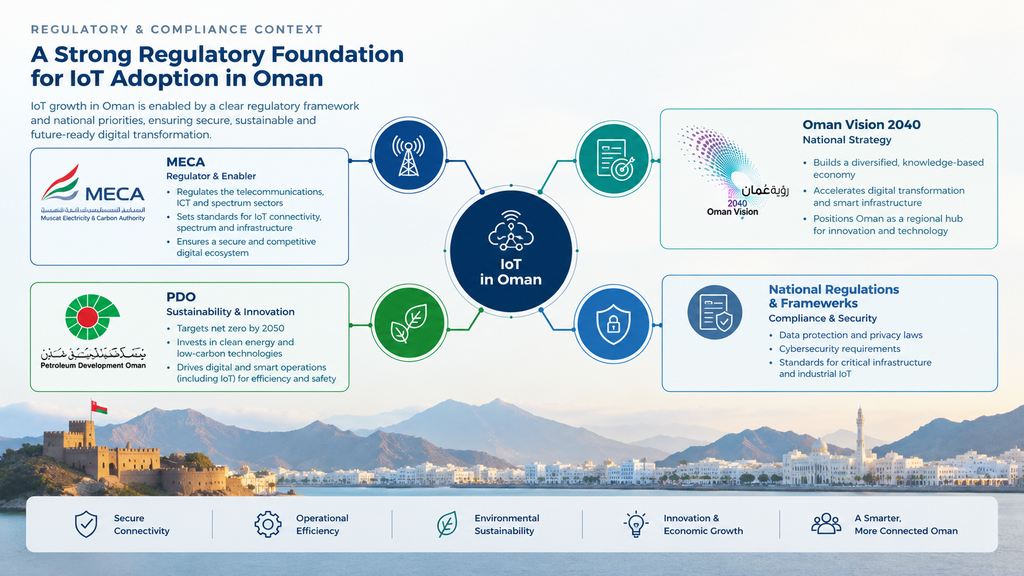
Three regulatory frameworks are having the most direct impact on IoT monitoring adoption across Omani industries:
MECA Environmental Compliance requires industrial facilities to monitor and report environmental parameters including air quality, emissions, and waste management. For facilities in designated industrial zones, the reporting frequency and data granularity required by MECA’s permit conditions effectively mandate continuous automated monitoring, manual logs are no longer sufficient.
Oman’s National Energy Strategy sets sector-specific energy intensity reduction targets for industry, commercial buildings, and government facilities. Organizations subject to these targets need the consumption data that IoT solutions provide to demonstrate progress, identify efficiency opportunities, and generate the reports that regulatory bodies accept.
MSX Sustainability Reporting, since January 2025, Muscat Stock Exchange-listed companies must disclose against 30 GRI-aligned ESG metrics. Environmental data collection through IoT monitoring systems is the most efficient way to build the data infrastructure these disclosures require, particularly for organizations that previously had no systematic environmental data collection in place.
What Elidiso Is Seeing in Oman Deployments
As a company based in Muscat with deployments across Oman’s industrial and commercial sectors, Elidiso observes several consistent patterns in how organizations are approaching IoT solutions Oman deployments in 2026:
Starting with environmental monitoring, expanding to energy. Most organizations begin their IoT journey with temperature and humidity monitoring, either driven by a specific compliance requirement or a product loss incident and then expand into energy monitoring and network infrastructure visibility as the value of the platform becomes clear to operations teams.
Wired over wireless for industrial environments. In Oman’s industrial zones, where electrical noise from heavy machinery and extreme heat affect wireless signal reliability, Modbus RTU over RS-485 wired sensor networks consistently outperform wireless alternatives. The reliability and noise immunity of wired industrial IoT solutions in these environments is not a theoretical advantage, but it is a documented operational difference.
Compliance first, optimization second. The primary driver for most Omani IoT deployments is compliance documentation, proving to MECA, auditors, or insurance providers that environmental conditions were monitored and within acceptable ranges. The operational efficiency benefits, predictive maintenance, energy optimization, process improvement, typically emerge as a secondary value layer once the monitoring infrastructure is in place.
Multi-site visibility is a priority from day one. Organizations operating across Oman’s geographically dispersed industrial zones: Sohar, Muscat, Duqm, Salalah, and consistently prioritize remote monitoring system capability that aggregates data from all sites into a single dashboard. The distances involved make on-site monitoring impractical, and the operational complexity of managing multiple separate systems is a pain point that a unified platform directly addresses.
How Elidiso Supports IoT Deployment Across Oman
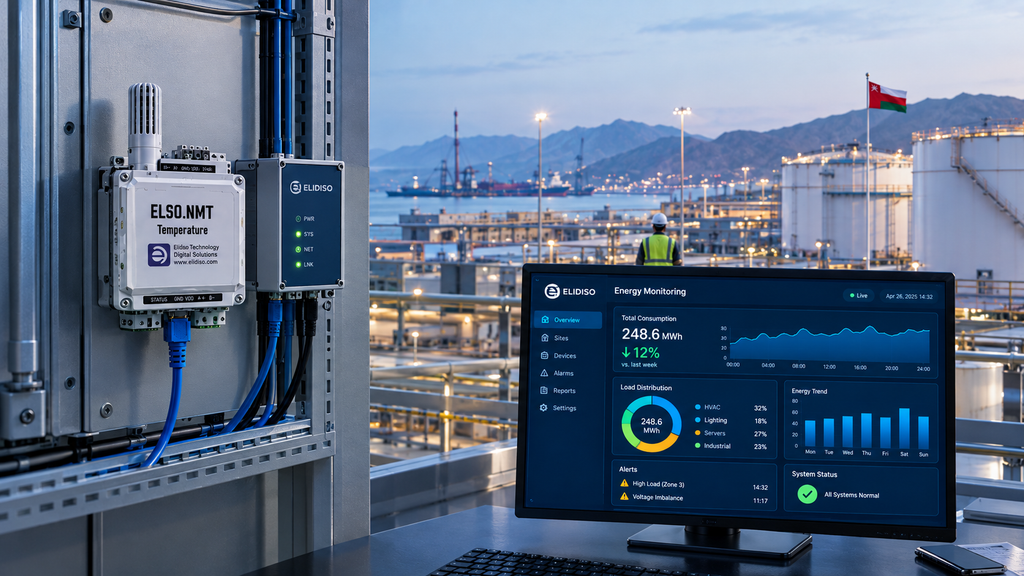
Elidiso is based in Muscat and has been delivering IoT solutions Oman organizations depend on across environmental monitoring, network monitoring, and energy management since our founding. Our hardware, the ELSO.NMxx Modbus sensor series, ELSO.NSxx standalone sensors, and Elidiso Modbus Gateway is designed and tested for Oman’s specific operating conditions: high ambient temperatures, coastal humidity, and the dust and electrical noise environments of Sohar and Duqm industrial zones.
Our EMS monitoring software platform gives Omani organizations the real-time dashboards, threshold alerts, compliance reports, and multi-site visibility they need to meet MECA requirements, satisfy MSX sustainability disclosure obligations, and build the operational monitoring infrastructure that Vision 2040’s industrial diversification agenda demands.
Contact Elidiso today to discuss your facility’s monitoring requirements and find out how our IoT solutions can be deployed across your Oman operations.
Leave a Reply