Author: cms.user

  • Environmental Monitoring in the Middle East: Challenges, and IoT Solutions

    Environmental Monitoring in the Middle East: Challenges, and IoT Solutions

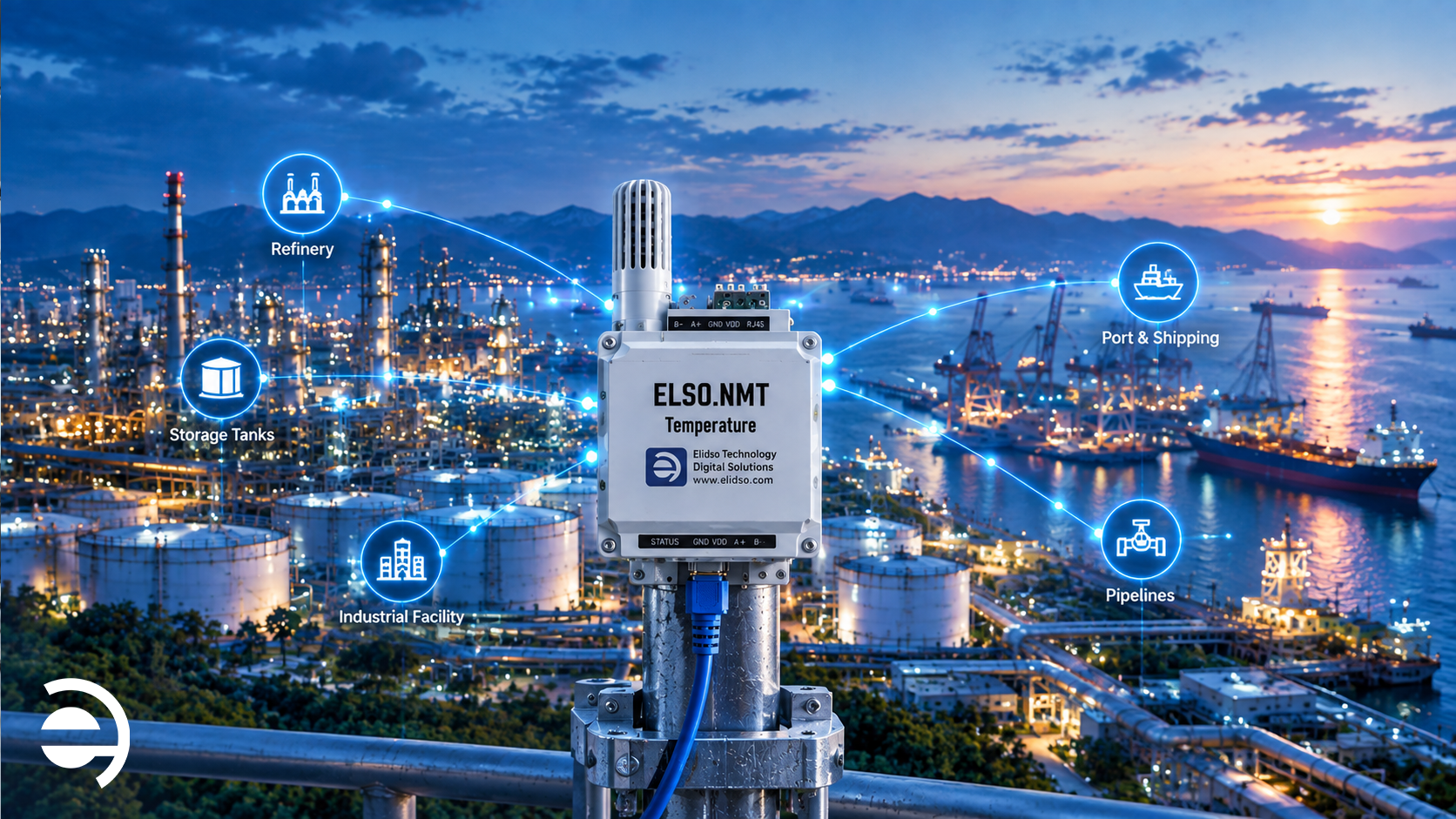
    The Middle East is one of the most environmentally demanding operating regions in the world. Extreme heat, intense humidity along coastal zones, pervasive dust, and some of the highest industrial energy consumption rates globally create conditions that push facilities, equipment, and operations to their limits. For organizations which require managing factories, warehouses, data centers, logistics hubs, or commercial buildings across the GCC, environmental monitoring in the Middle East is not simply a best practice, but it is increasingly a regulatory requirement and a direct operational necessity.

    For any organization with operations in the region, understanding the specific demands of environmental monitoring and Middle East conditions, from extreme heat and humidity to increasingly stringent regulatory requirements, is the foundation for building a resilient, compliant facility. This article examines the key environmental challenges, the regulatory landscape across Oman, UAE, and Saudi Arabia, and how industrial IoT solutions are helping organizations in Oman, the UAE, Saudi Arabia, and beyond gain the real-time visibility they need to protect assets, ensure compliance, and operate efficiently.

    Why Environmental Monitoring in the Middle East Is Uniquely Challenging

    Facilities in the GCC and broader Middle East face environmental conditions that are significantly more demanding than those in temperate regions. Understanding these challenges is the starting point for designing an effective environmental monitoring system.

    Extreme Heat

    Summer temperatures regularly exceed 45°C across the Arabian Peninsula, with ground-level and industrial surface temperatures often reaching 60–70°C. For sensitive equipment, electronics, HVAC systems, server infrastructure, and manufacturing machinery, sustained heat exposure accelerates degradation, increases failure rates, and drives up energy consumption. A robust remote monitoring system that tracks temperature continuously across all critical zones is the first line of defense against heat-related equipment failure.

    High Humidity and Coastal Corrosion

    Along the Gulf Coast, from Muscat to Dubai, Abu Dhabi, and Doha, relative humidity can exceed 90% during summer months. High moisture levels accelerate corrosion of metal components, degrade electrical insulation, promote mold growth in controlled environments, and compromise the accuracy of unprotected sensors. Facilities in coastal industrial zones must monitor humidity continuously to protect both assets and product quality.

    Dust and Particulate Matter

    Sandstorms and persistent airborne dust are a defining environmental challenge across the region, particularly in Oman, Saudi Arabia, and the UAE. Dust infiltration damages cooling systems, clogs filtration units, coats solar panels, and contaminates cleanrooms and pharmaceutical facilities. Air quality monitoring IoT sensors that track PM2.5 and PM10 particulate levels in real time give facilities early warning of dust events and enable automated responses before damage occurs.

    Energy Consumption and Peak Load Pressure

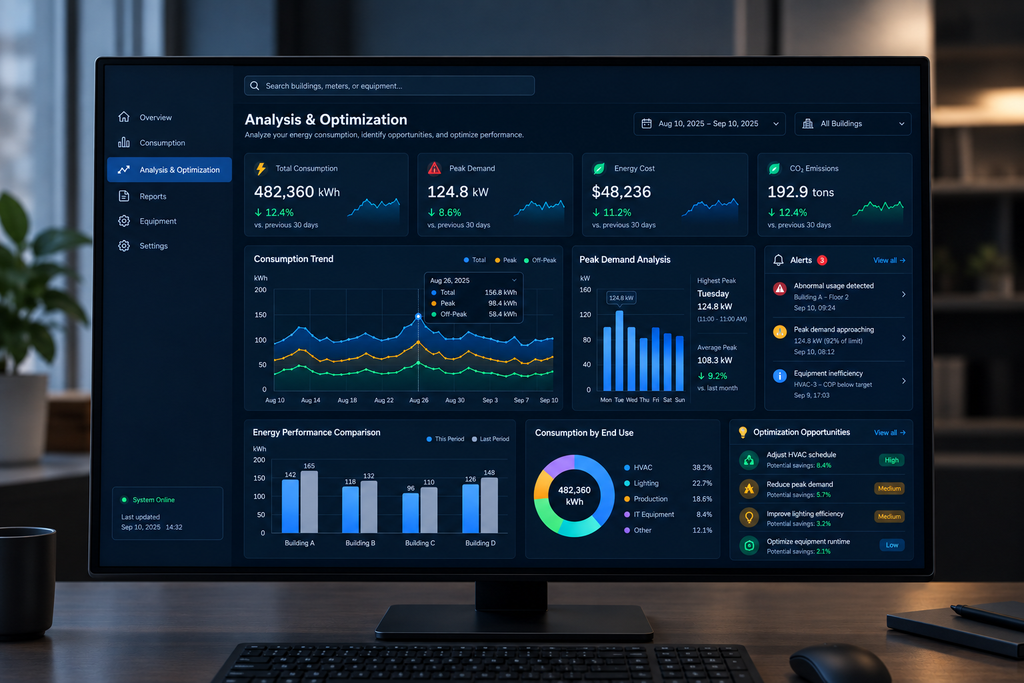
    The GCC has some of the highest per-capita energy consumption rates in the world, driven largely by cooling demand. As governments across the region push toward diversification and sustainability targets, UAE Net Zero 2050, Saudi Vision 2030’s energy efficiency components, Oman’s 2040 sustainability roadmap, facilities face growing pressure to monitor, report, and reduce energy consumption. Smart facility management platforms powered by IoT sensors are becoming the primary tool for meeting these obligations.

    The Regulatory Landscape Driving Environmental Monitoring Demand

    Regulation is now one of the primary drivers of environmental monitoring Middle East investment. The pace of legislative change across the GCC means organizations can no longer treat monitoring as optional and those that have not yet built a continuous environmental monitoring in the Middle East at a pace that was not seen five years ago. Organizations operating across the GCC now face binding compliance requirements that make continuous environmental monitoring not optional but mandatory.

    UAE — Federal Environmental Law and GHG Reporting

    The UAE passed Federal Decree-Law No. 11 on the Reduction of Climate Change Effects in August 2024, which took effect in May 2025. The law mandates that all public and private entities — including those in Free Zones report on their greenhouse gas emissions and submit emissions-reduction plans. Full compliance was required by May 2026, with penalties of up to AED 2 million for non-compliance. For industrial facilities, this makes continuous emissions and environmental monitoring a legal obligation.

    Saudi Arabia — RCER-2025 and NCEC Reporting

    Saudi Arabia’s Royal Commission Environmental Regulations (RCER-2025) significantly tightened environmental compliance requirements for industrial operators. Continuous Emissions Monitoring Systems (CEMS) are now mandatory for stacks above 2 MW thermal input, and hourly automated data transmission to the NCEC’s central platform is required, manual reporting is no longer accepted. Environmental permit applications are now fully digitalized, with processing times reduced by 40% through the NCEC platform.

    Oman — MECA and Mandatory ESG Disclosure

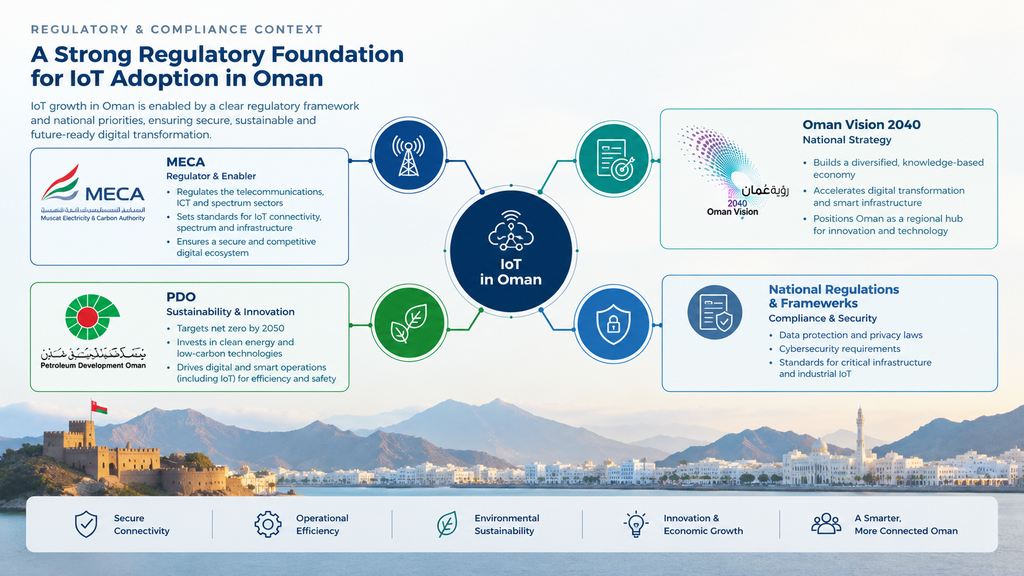
    Oman’s Ministry of Environment and Climate Affairs (MECA) governs environmental permitting and compliance for industrial facilities. Since January 2025, the Muscat Stock Exchange has mandated sustainability reporting for all listed companies, requiring disclosure against 30 GRI-aligned environmental, social, and governance metrics. For facilities operating in Oman’s industrial zones, Sohar, Duqm, Salalah, IoT solutions Oman that automate environmental data collection and reporting are increasingly essential for meeting these obligations efficiently.

    GCC-Wide Air Quality Initiatives

    In January 2025, the GCC launched a joint air quality monitoring network spanning 36 cities across the region, using real-time sensors and satellite data to track particulate matter and pollutants. This regional initiative signals a clear direction: governments across the Gulf are investing in environmental data infrastructure, and the expectation is that industrial facilities will follow with their own internal air quality monitoring IoT systems to align with national and regional standards.

    How Industrial IoT Solutions Address Middle East Environmental Challenges

    The growth of industrial IoT solutions in the Middle East reflects the scale of the environmental challenge. The Middle East and Africa IoT sensors market is projected to add USD 7.81 billion between 2026 and 2031, driven by government investment, multinational industrial participation, and the region’s accelerating digital transformation. The environmental sensor market in the Middle East and Africa alone is forecast to reach USD 222.7 million by 2034.

    Modern environmental monitoring systems built on IoT technology address the region’s specific challenges through three core capabilities:

    Real-Time Visibility Across All Parameters

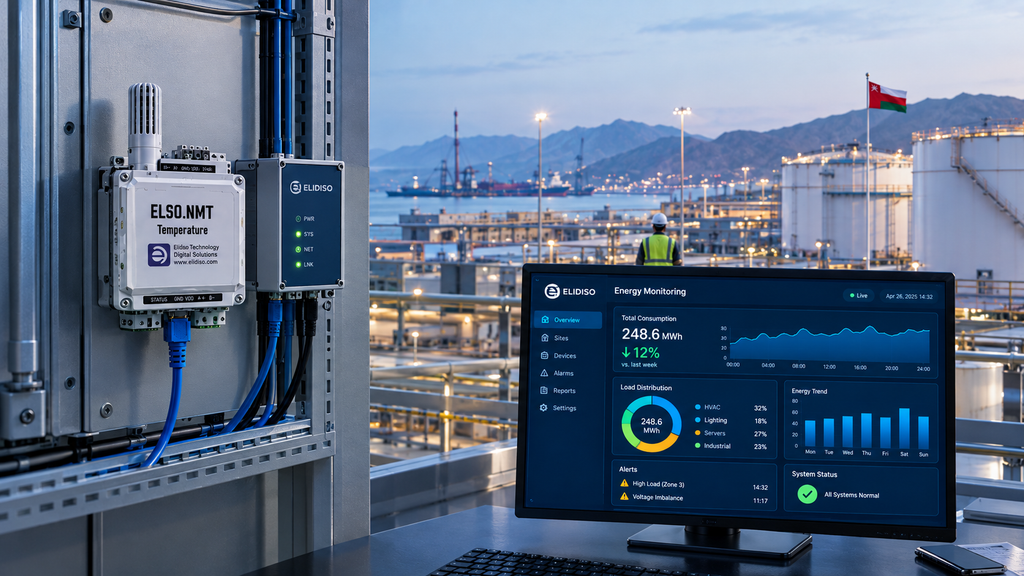
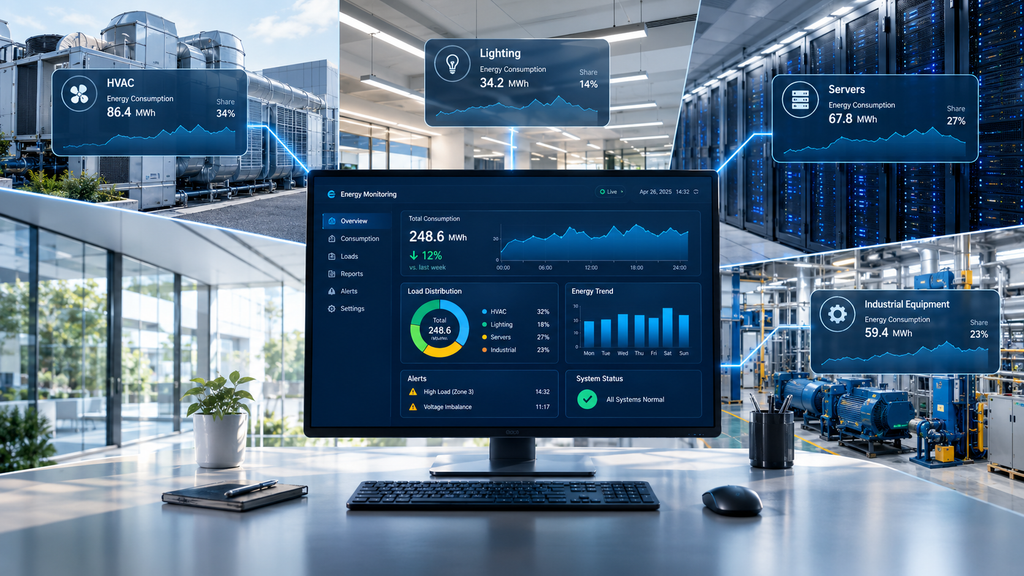
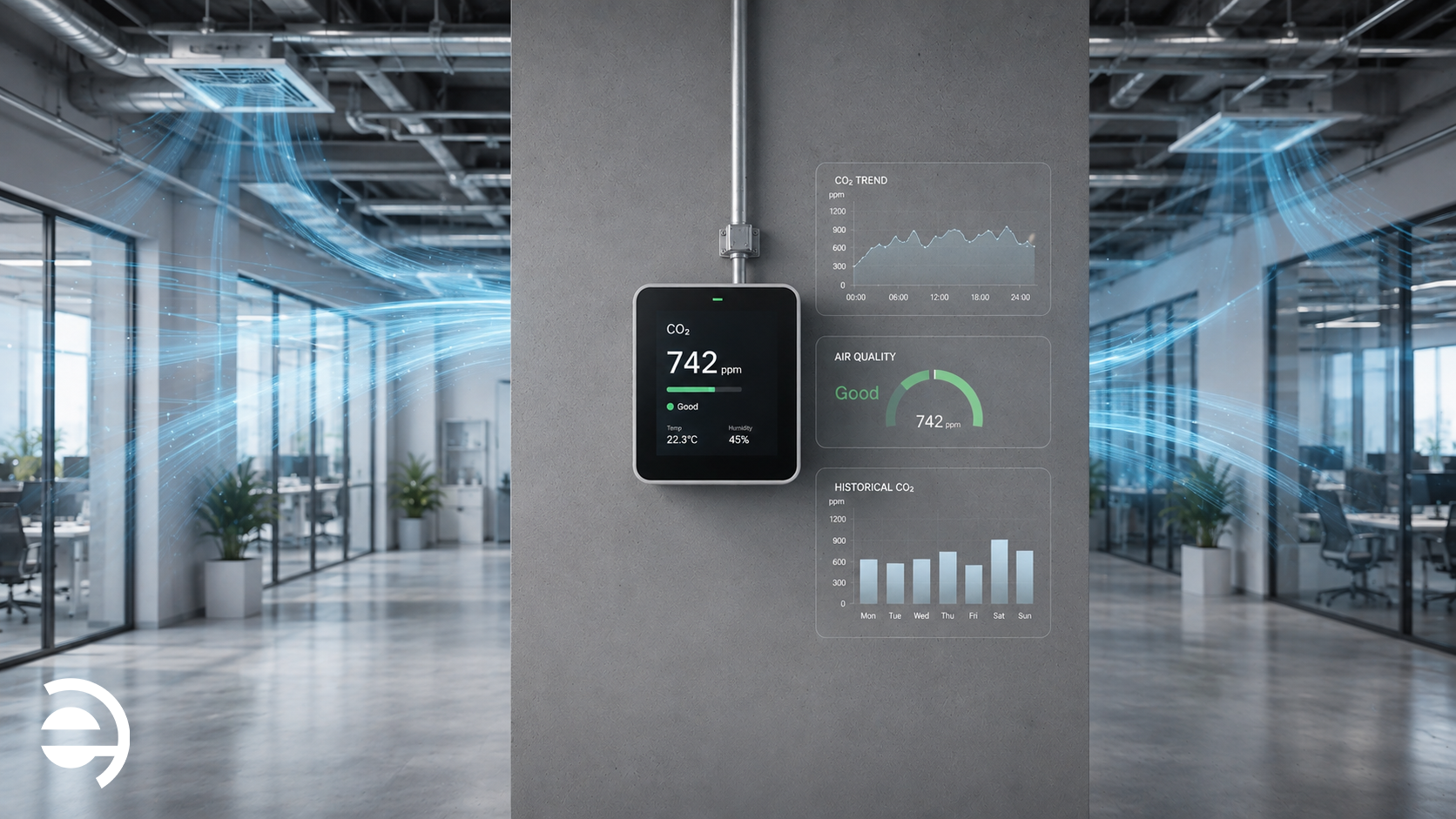
    Industrial IoT sensors deployed across a facility continuously measure the parameters that matter most in a Middle Eastern operating environment: temperature, humidity, CO₂ concentration, particulate matter (PM2.5/PM10), air pressure, light levels, and energy consumption. Data is transmitted in real time to a centralized remote monitoring system dashboard, giving operations teams instant visibility across every zone, from server rooms and cleanrooms to warehouse floors and outdoor equipment yards.

    This real-time visibility eliminates the blind spots that manual monitoring creates and in a region where a two-hour temperature excursion can damage a batch of pharmaceuticals or trigger equipment failure, the ability to detect and respond immediately is not a luxury but an operational requirement.

    Automated Alerting and Threshold Management

    Effective environmental monitoring in the Middle East means the system does not just record data, it acts on it. IoT monitoring platforms allow operations teams to define threshold values for every parameter, triggering automated alerts, via SMS, email, or dashboard notification, when readings exceed acceptable ranges. During a sandstorm, for example, a sudden spike in PM10 readings triggers an alert to close ventilation intakes. A temperature anomaly in a server room triggers an immediate escalation before equipment reaches critical levels.

    Compliance Documentation and Audit Trails

    For facilities operating under UAE, Saudi, and Omani environmental regulations, the ability to generate audit-ready compliance reports is as important as the monitoring itself. Modern smart facility management platforms automatically log all sensor readings with timestamps, generate exception reports when thresholds are breached, and produce the structured data exports required for regulatory submission, eliminating the manual data collection burden that previously consumed significant time from operations and compliance teams.

    Environmental Monitoring Middle East: Key Industry Applications

    IoT solutions GCC deployments for environmental monitoring span a wide range of industrial and commercial sectors:

    • Oil and gas facilities — Monitoring temperature, gas concentration, and air quality across upstream and downstream operations for both operational efficiency and HSE compliance
    • Data centers — Continuous temperature and humidity monitoring to maintain uptime SLAs in facilities where cooling failure has immediate business impact
    • Pharmaceutical and food production — Environmental compliance monitoring for cleanrooms, cold storage, and regulated production areas under GCC health authority requirements
    • Logistics and warehousing — Temperature and humidity monitoring across large warehouse footprints, particularly for temperature-sensitive goods in transit or storage
    • Commercial real estate and smart buildingsEnergy monitoring, HVAC performance tracking, and indoor air quality management for mixed-use commercial developments
    • Renewable energy — Performance and environmental monitoring for solar installations, where dust accumulation and temperature affect panel efficiency across the region’s rapidly expanding solar portfolio

    Choosing an Environmental Monitoring Middle East Solution: What to Look For

    Not all environmental monitoring systems are designed for the conditions found in the Middle East. When evaluating industrial IoT sensors and monitoring platforms for GCC deployment, operations and procurement teams should prioritize:

    • Operating temperature range — Sensors must be rated for ambient temperatures of 55°C or above for outdoor or non-climate-controlled applications
    • IP rating — IP65 or higher for dust and moisture resistance in industrial environments; IP67 or IP68 for outdoor coastal deployments
    • Communication protocol reliability — Wired protocols such as Modbus RTU over RS-485 offer superior noise immunity in electrically demanding industrial environments
    • Scalability — The system should handle expansion from a single facility to multi-site operations across the GCC without requiring a platform change
    • Regulatory reporting capability — Built-in report generation that meets the data format and frequency requirements of UAE, Saudi, and Omani regulatory bodies
    • Local support — Given the region’s specific compliance environment, having a supplier with local technical expertise and after-sales support is essential

    How Elidiso Supports Environmental Monitoring Middle East Operations

    Elidiso specializes in industrial IoT solutions for environmental and operational monitoring across the Middle East, Africa, and Europe. Based in Oman, with experience serving clients across the GCC, our environmental monitoring systems are designed for the region’s specific conditions, from the heat and humidity of coastal Gulf facilities to the dust and temperature extremes of inland industrial sites.

    Our integrated stack, industrial-grade IoT sensors, Modbus gateways, and EMS monitoring software, gives facility managers, operations directors, and sustainability teams a complete remote monitoring system that covers every parameter, every zone, and every compliance requirement their operations face.

    Whether you need an environmental monitoring Middle East solution for a single facility or a multi-site network across the GCC, Elidiso has the hardware, software, and regional expertise to deliver. environmental monitoring system for a new facility, upgrading a legacy setup to meet current regulatory requirements, or expanding coverage across multiple sites, Elidiso has the hardware, software, and regional expertise to deliver.

    Contact our team today to discuss your requirements and receive a solution tailored to your Middle East operations.
  • Card Printer Consumables: A Complete Guide to Ribbons, and Card Stock

    Card Printer Consumables: A Complete Guide to Ribbons, and Card Stock

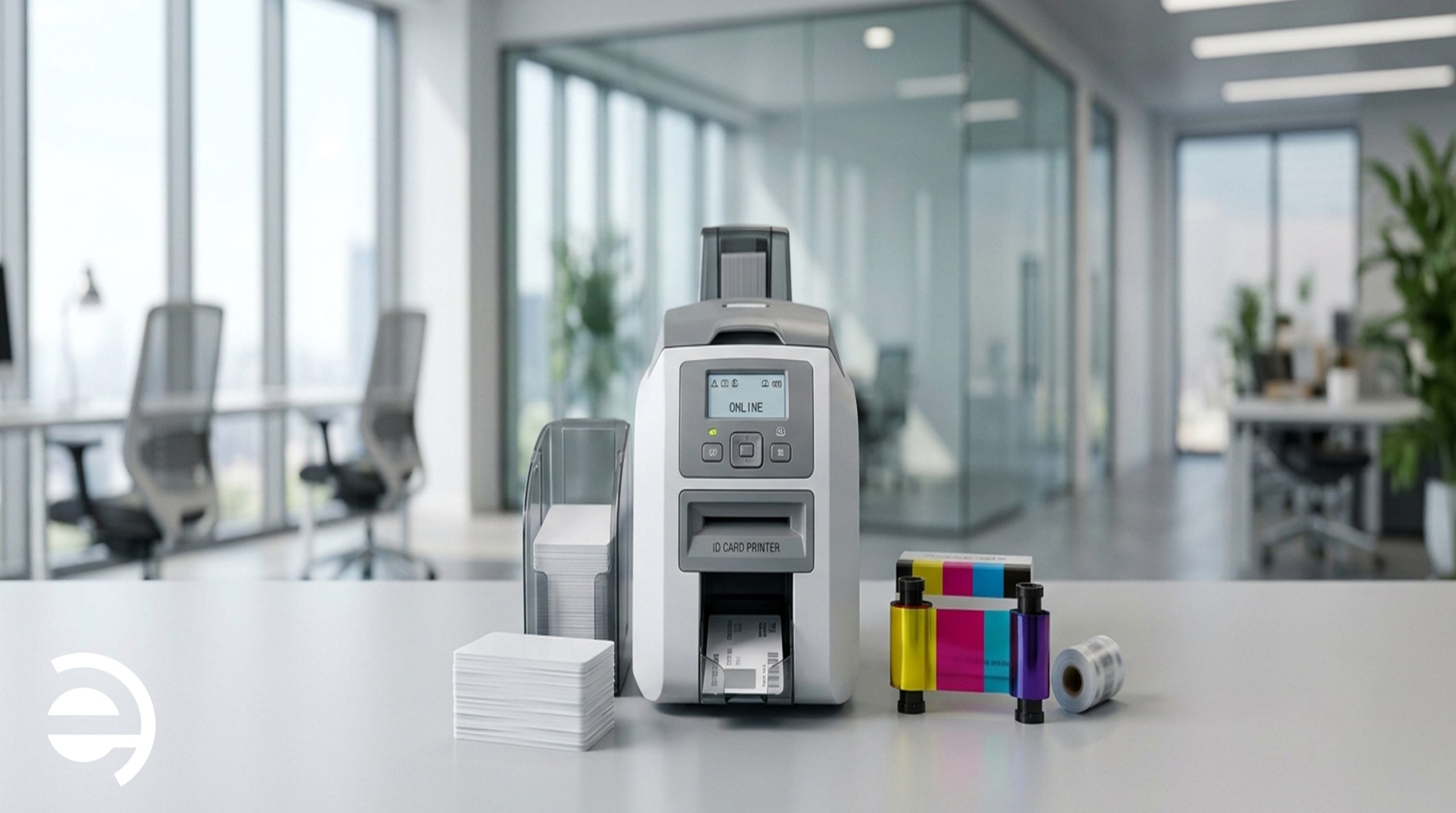
    Running a professional ID card printing program involves more than just the hardware. Selecting the right card printer consumables, ribbons, overlaminates, and blank card stock, which directly determines the quality, durability, and security of every badge you produce. Yet for many HR teams and procurement managers, card printer consumables are an afterthought until something goes wrong.

    This guide is a comprehensive reference on card printer consumables, e.g. for what they are, how to choose the right ones, and how they affect the output your organization depends on every day.

    What Are Card Printer Consumables?

    Card printer consumables are the materials consumed during the printing process, the components that need to be replenished regularly as cards are produced. The three main categories are:

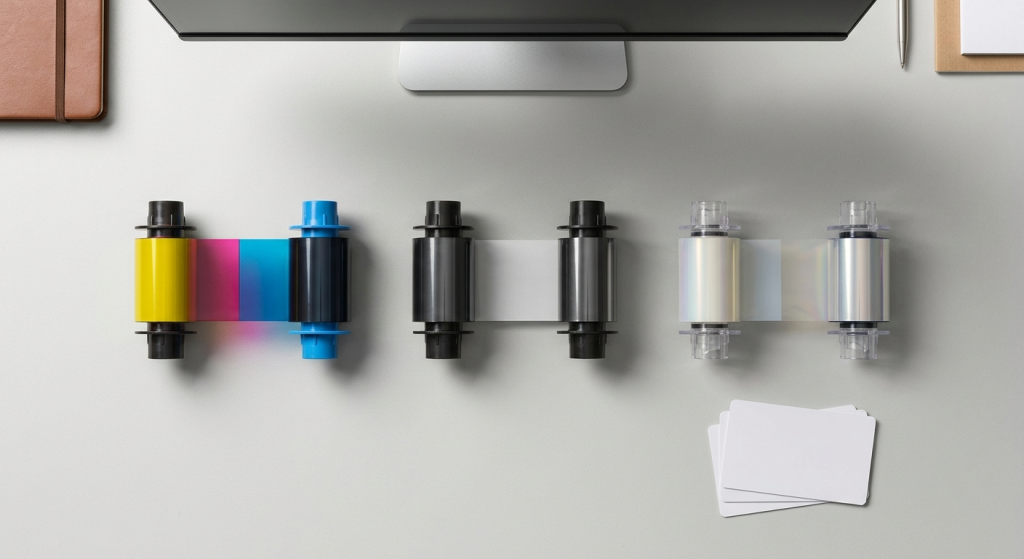
    • Ribbons — the primary consumable, containing the ink or film that transfers images and data onto the card surface
    • Overlaminates — protective films applied over the printed card to enhance durability and security
    • Blank card stock — the physical cards onto which content is printed

    Choosing the wrong consumable for your printer model or use case leads to poor print quality, premature wear on the printhead, or cards that fail to meet security requirements. Understanding each category is the first step to getting it right.

    Card Printer Ribbons: Types and When to Use Each

    The ribbon is the most frequently replaced card printer consumable and the one with the widest variety of options.

    Selecting the correct ribbon type is critical, using an incompatible or incorrect ribbon can permanently damage your printhead, which is one of the most expensive components in any card printer.

    YMCK Ribbon — Full Color with Black Panel

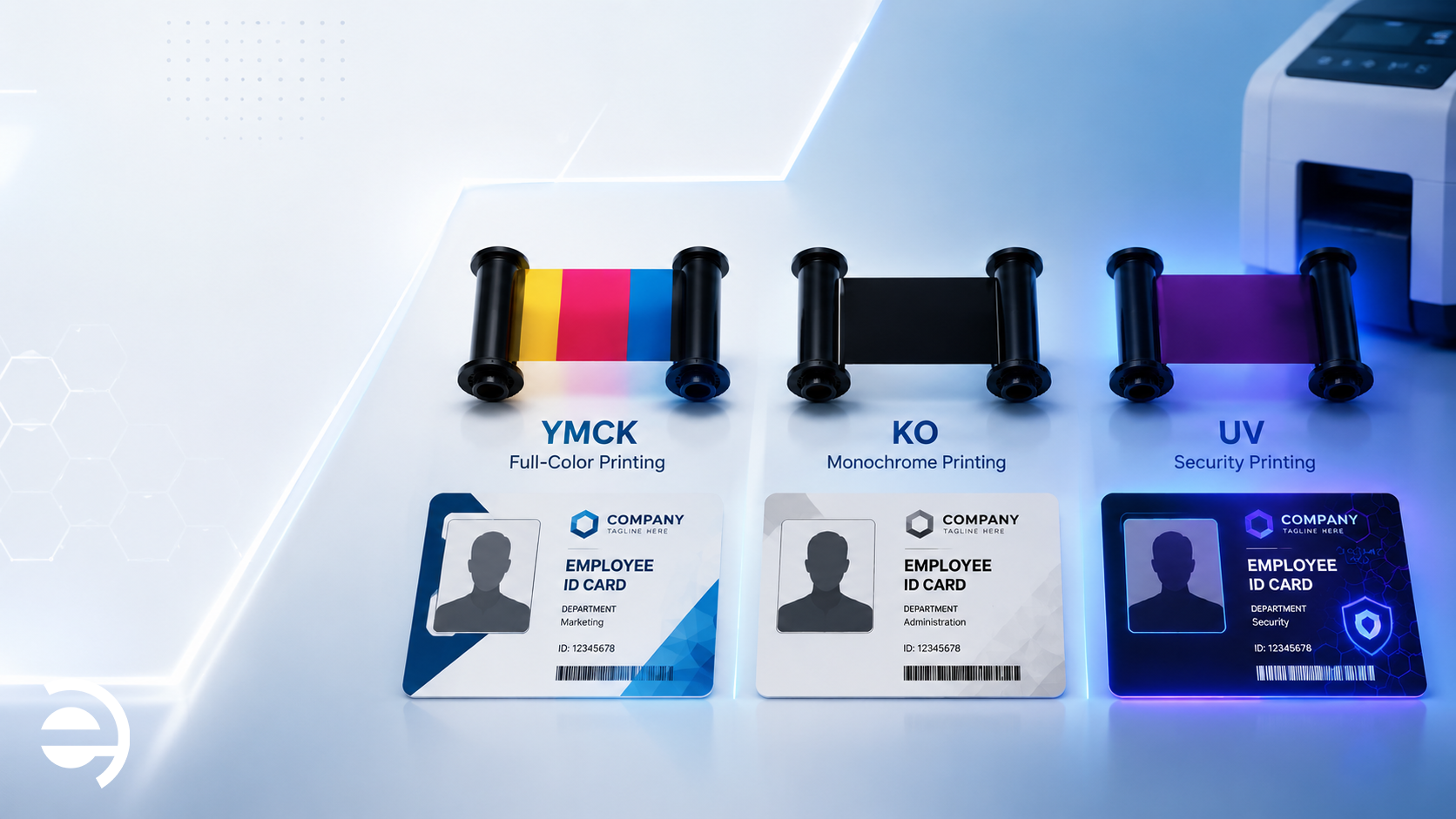
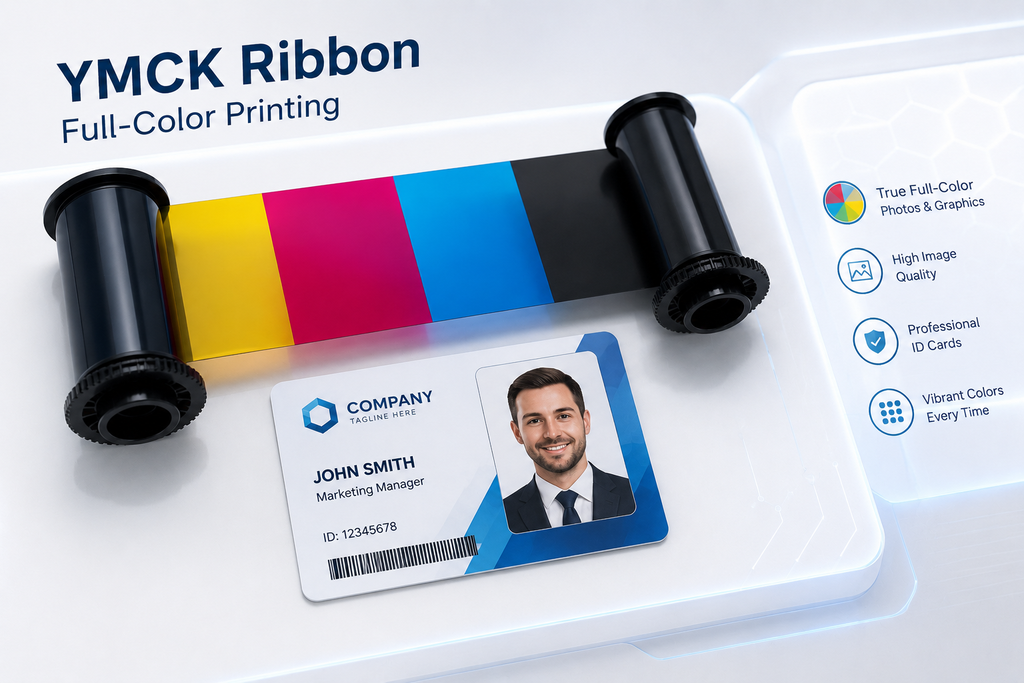
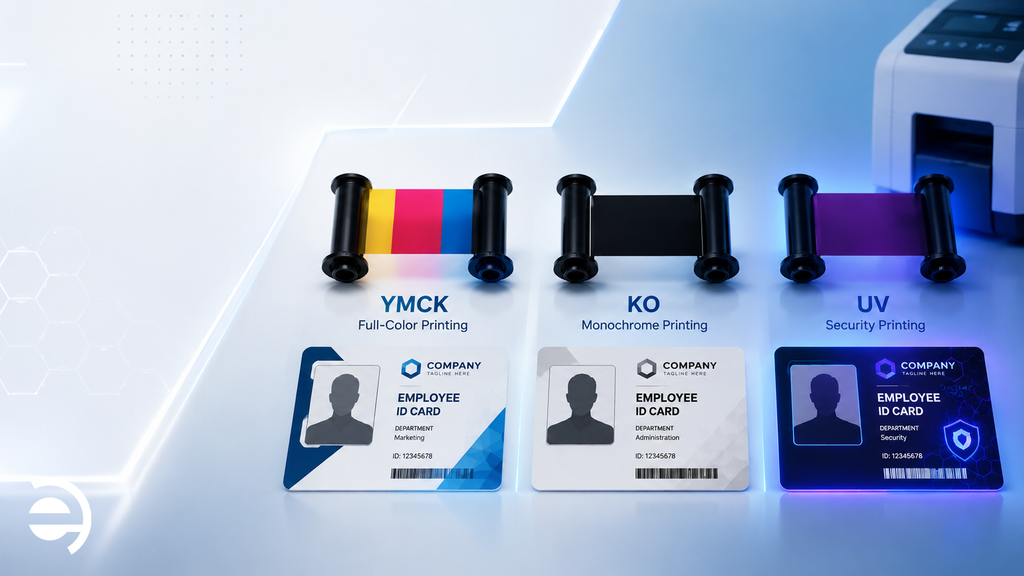
    The YMCK ribbon is the standard choice for full-color photo ID badges. It contains four panels per card cycle: Yellow (Y), Magenta (M), Cyan (C), and Black (K). The three color panels combine to produce the full-color image, employee photos, logos, background graphics, while the black panel prints crisp, sharp text and barcodes.

    YMCK ribbons are suitable for most corporate employee ID programs, visitor badges, and access control cards where a professional color photo ID is required. They offer a good balance of color quality, card yield, and cost per card.

    YMCKO Ribbon — Full Color with Overlay Panel

    The YMCKO ribbon adds a fifth panel: a clear overlay (O) that is applied over the printed surface after the color and black layers. This overlay provides a basic level of protection against everyday handling, moisture, and minor abrasion, extending card lifespan without the need for a separate overlaminate.

    YMCKO ribbons are a popular choice for mid-volume programs where cards need moderate durability but a full security overlaminate is not required. The trade-off versus a separate overlaminate is lower tamper resistance and less protection against UV fading.

    YMCKOK Ribbon — Dual Black Panel

    The YMCKOK ribbon includes two black panels, one resin black for printing on the front of the card, and one for the back. This is the right choice when your card design requires full-color printing on the front and text, barcodes, or a magnetic stripe encoding layer on the reverse side.

    Common applications include dual-sided employee badges with department information or access level data printed on the back, and transit or loyalty cards with variable data on both sides.

    KO Ribbon — Monochrome with Overlay

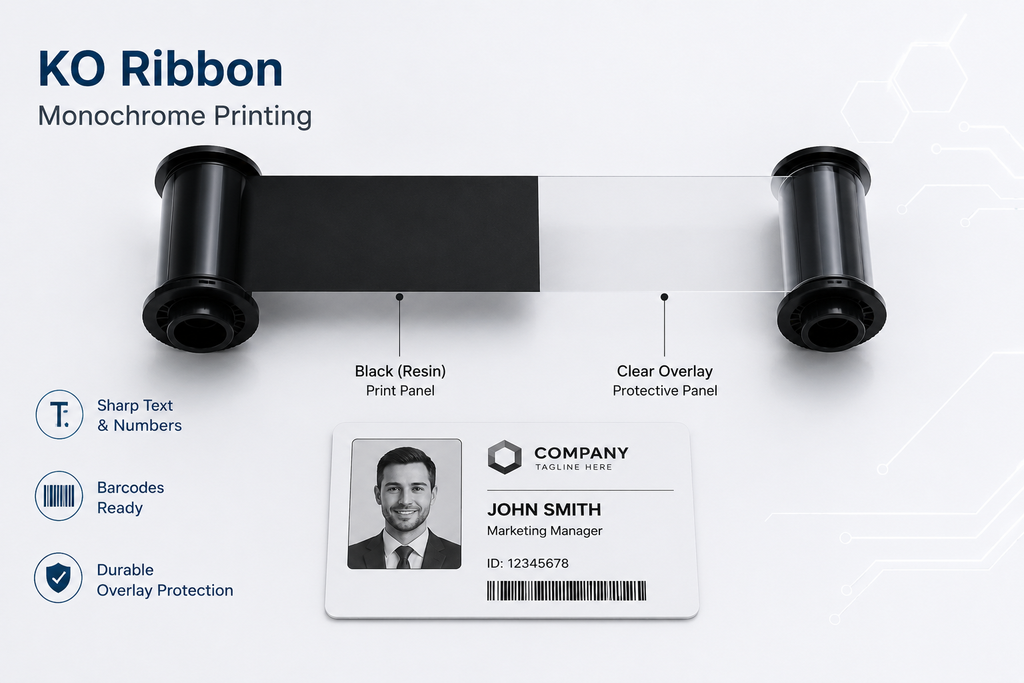
    The KO ribbon prints in a single color, typically black, but also available in blue, red, white, gold, and silver, plus a clear overlay panel. It is used when full-color printing is not required: for example, temporary visitor passes, single-color loyalty cards, or membership cards where cost efficiency takes priority over visual complexity.

    Monochrome ribbons yield significantly more cards per ribbon than full-color options, making them the most cost-effective choice for high-volume, low-complexity card programs.

    UV Ribbon — Ultraviolet Security Printing

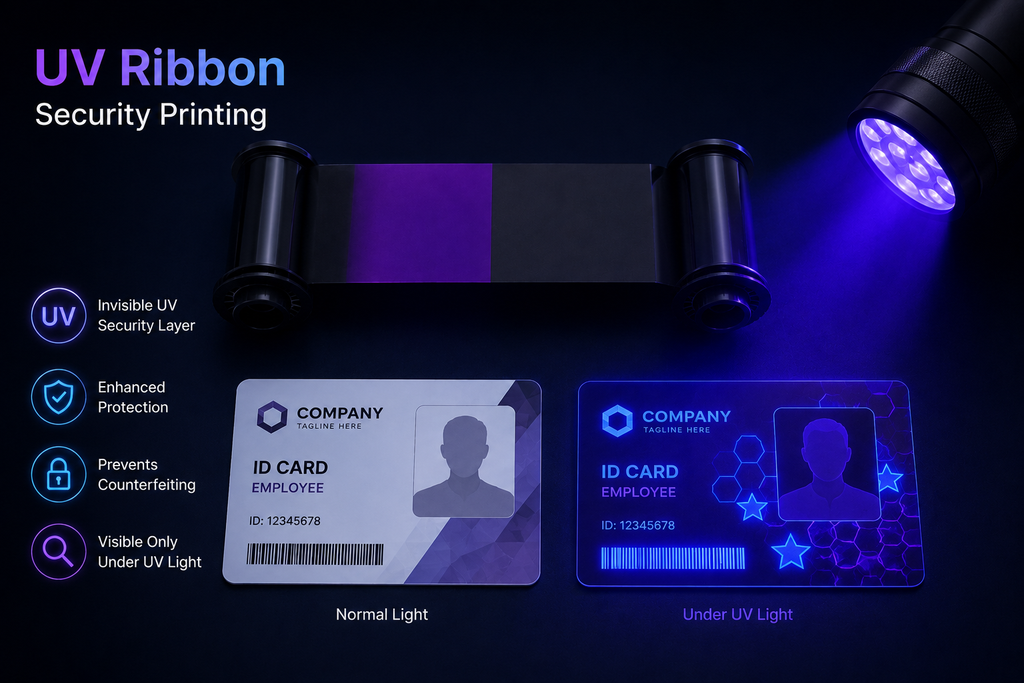
    The UV ribbon prints content that is invisible under normal lighting but clearly visible under an ultraviolet (black) light. UV printing adds a covert security layer to an ID card, logos, patterns, or text that cannot be seen or easily replicated without specialist equipment.

    UV ribbons are used in combination with a standard YMCK or KO ribbon as part of a multi-layer security card program. They are particularly common in government IDs, high-security corporate environments, university cards, and event credentials where counterfeit prevention is a priority.

    Overlaminates: Why They Matter More Than Most Teams Realize

    An overlaminate is a thin film, typically 0.5 to 1 mil thick, that is applied over the entire printed card surface using heat and pressure. It is the single most effective way to extend card lifespan and add tamper-evident security features to an ID badge.

    There are two main overlaminate types:

    Clear Overlaminate

    A clear overlaminate provides physical protection without altering the visual appearance of the card. It creates a hard, smooth surface that resists scratching, moisture, UV fading, and everyday handling damage. For most corporate ID programs, a clear overlaminate can extend card lifespan from 12–18 months to 3–4 years under normal use conditions.

    Holographic Overlaminate

    A holographic overlaminate adds a visible security feature: a repeating holographic pattern, typically a logo, geometric design, or custom motif, that shifts appearance when viewed from different angles. This pattern is extremely difficult to replicate without specialist manufacturing equipment, making holographic overlaminates the standard choice for high-security ID programs.

    Any attempt to peel or tamper with a holographic overlaminate destroys the card surface visibly, making tampering immediately detectable. For organizations where credential integrity is critical, holographic overlaminates are a non-negotiable element of the card security architecture.

    Blank Card Stock: Choosing the Right Material

    Blank card stock is an often-overlooked category of card printer consumables, yet the material you choose directly affects print quality, encoding compatibility, and card lifespan. The main options are:

    • PVC cards (CR-80) — The industry standard for most ID programs. 85.6mm x 54mm, 0.76mm thick. Compatible with direct-to-card printers and most encoding options. Best for standard employee IDs with moderate daily use and a lifespan of 1–2 years.
    • Composite cards (PVC/PET blend) — More dimensionally stable than standard PVC, with better resistance to heat and bending. Required for retransfer printing and recommended for smart card applications. Lifespan of 3–4 years under normal use.
    • Polycarbonate cards — The highest-security card material. Used in government IDs, high-assurance corporate credentials, and national identity documents. Laser-engraved data is embedded within the card layers and cannot be separated or altered without destroying the card.

    It is important to use card stock specified or approved for your printer model. Off-brand or incompatible cards can cause jams, inconsistent print quality, and accelerated wear on the printer’s rollers and printhead.

    How to Match Consumables to Your Printer and Use Case

    Matching card printer consumables to your specific situation depends on three factors:

    1. Your Printer Model

    Card printer ribbons are not universal. Each printer manufacturer uses a proprietary ribbon cartridge format; Matica, Fargo (HID), and Zebra all use different ribbon systems. Always source ribbons certified for your specific printer model. Using third-party or uncertified ribbons voids most manufacturer warranties and risks printhead damage.

    2. Your Card Volume

    Higher-volume programs benefit from high-capacity ribbon options that yield more cards per cartridge, reducing the frequency of ribbon changes and lowering cost per card. For programs printing fewer than 500 cards per year, standard-capacity ribbons are typically sufficient.

    3. Your Security Requirements

    Low-security environments, visitor passes, temporary badges, canteen cards, can use standard YMCKO ribbons with no overlaminate. High-security programs, access control, government, financial services, should combine a YMCK ribbon with a holographic overlaminate and composite or polycarbonate card stock for maximum durability and tamper resistance.

    How Elidiso Supports Your Card Printer Consumables Program

    Elidiso supplies a full range of card printer consumables, ribbons, overlaminates, and blank card stock, for leading printer brands including Matica, Fargo (HID), and Zebra. Whether you are running a small HR team printer or a high-throughput enterprise issuance system, we supply the right card printer consumables to keep your program running without interruption.

    Our team can advise on the correct ribbon type, overlaminate, and card stock for your specific printer model, card design, and security requirements, ensuring you are not overspending on features you do not need, or under-specifying for the security level your organization requires.

    Contact Elidiso today to discuss your card printer consumables requirements and receive a tailored recommendation.

  • What Is a Modbus Sensor and Why It Matters for Industrial Monitoring?

    What Is a Modbus Sensor and Why It Matters for Industrial Monitoring?

    If you have ever explored industrial monitoring systems, you have almost certainly encountered the term Modbus sensor. It appears in product datasheets, system architecture diagrams, and procurement documents across manufacturing, energy, building management, and infrastructure sectors. But what does a Modbus sensor actually do and why does this technology still matter in 2026, decades after it was first introduced?

    This guide explains Modbus in plain terms, what a Modbus sensor is, how it fits into a complete monitoring system, and what facility managers, engineers, and operations teams need to know when evaluating industrial IoT solutions.

    What Is Modbus?

    Modbus is a communication protocol which contains a set of rules that defines how devices exchange data with each other. It was developed in 1979 by Modicon for use in programmable logic controllers (PLCs), making it one of the oldest and most established protocols in industrial automation.

    Despite its age, Modbus remains dominant in industrial environments for a simple reason: it works. It is robust, well-understood, vendor-neutral, and supported by virtually every industrial device manufacturer in the world. When engineers talk about industrial interoperability, Modbus is almost always part of the conversation.

    There are two main variants in active use today:

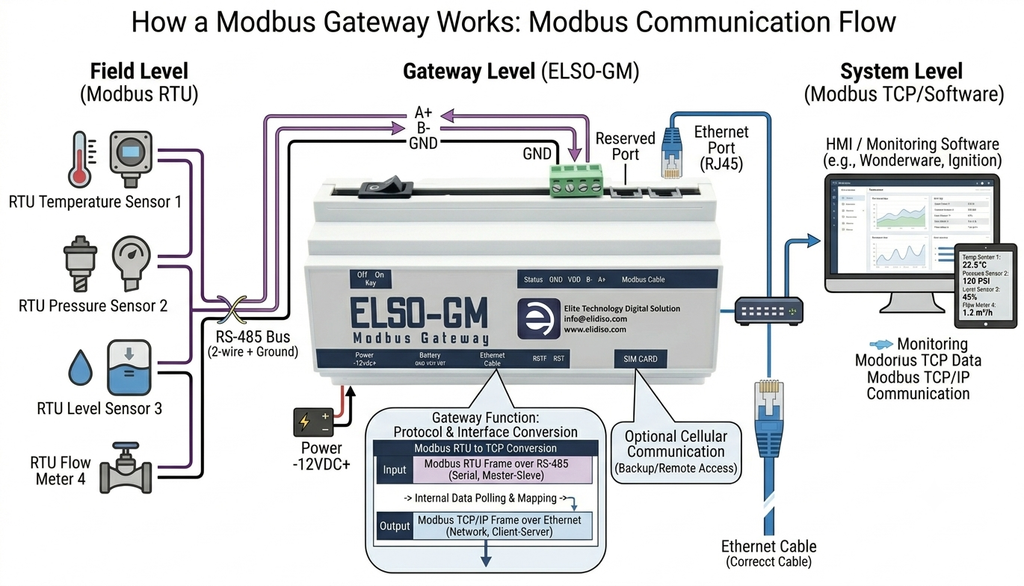
    • Modbus RTU — Communicates over serial wiring (RS-485 or RS-232). Compact, reliable, and well-suited to industrial environments where wired connections are practical. This is the most widely deployed variant.
    • Modbus TCP — Communicates over standard Ethernet or IP networks. Easier to integrate into modern IT infrastructure and suitable for longer distances and more complex network topologies.

    What Is a Modbus Sensor?

    A Modbus sensor is an environmental or industrial sensor that communicates using the Modbus protocol. Rather than simply outputting a raw analog signal (like a voltage or current), a Modbus sensor transmits structured digital data that can be read, logged, and acted upon by a connected monitoring system.

    Common parameters measured by Modbus sensors include:

    • Temperature — Air, surface, liquid, or soil temperature
    • Humidity — Relative humidity in ambient air or controlled environments
    • CO₂ concentration — Indoor air quality monitoring in offices, warehouses, and industrial facilities
    • Air pressure — Barometric or differential pressure for HVAC and cleanroom applications
    • Particulate matter (PM2.5 / PM10) — Dust and air quality in industrial and urban environments
    • Light levels — Illuminance monitoring for energy management and workplace compliance
    • Voltage and current — Electrical monitoring for energy consumption tracking

    Each sensor sits on a shared communication line, called a Modbus bus, and is assigned a unique address. When the master device (typically a gateway or controller) polls the bus, each sensor responds with its current reading. This polling architecture is simple, deterministic, and extremely reliable.

    How Does a Modbus Sensor Fit Into a Monitoring System?

    Understanding a Modbus sensor means understanding the system it sits within. A typical industrial environmental monitoring architecture has three layers:

    Layer 1 — Sensors

    Each Modbus sensor is deployed at the point of measurement, inside a factory, on an HVAC unit, in a server room, across a warehouse floor, or around a building perimeter. Each sensor continuously measures its parameter and holds the latest reading in memory until it is requested.

    Layer 2 — Gateway

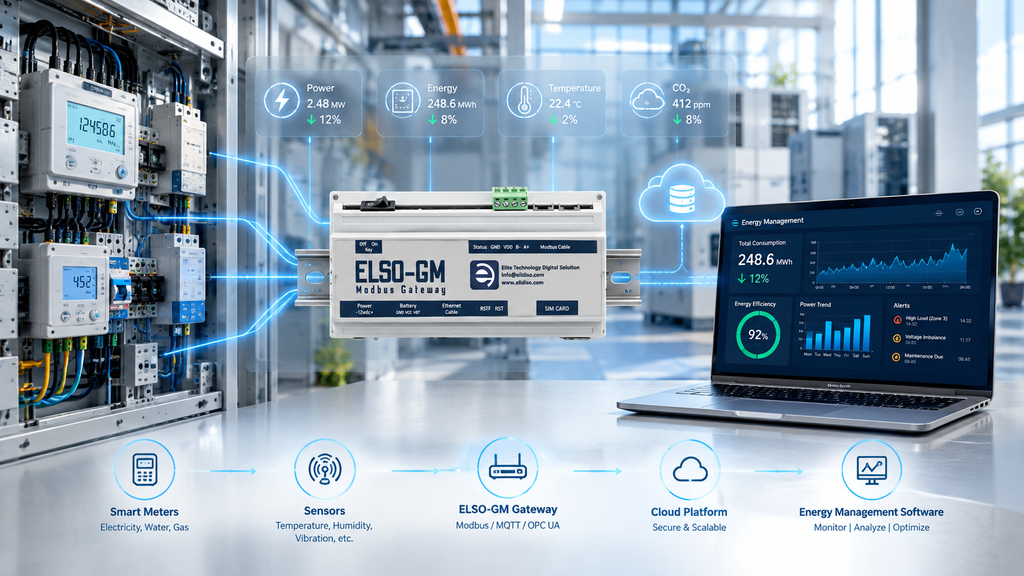
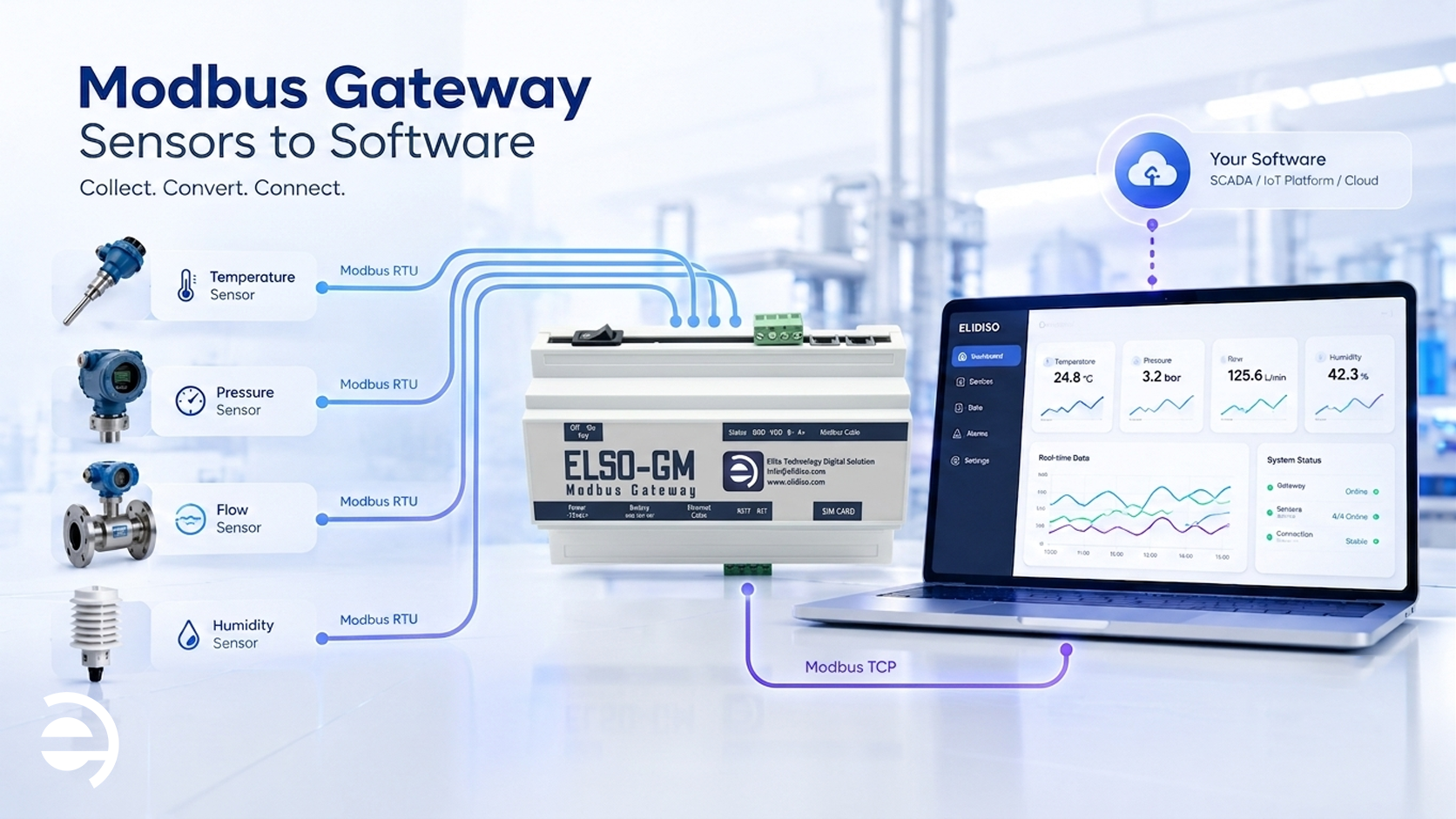
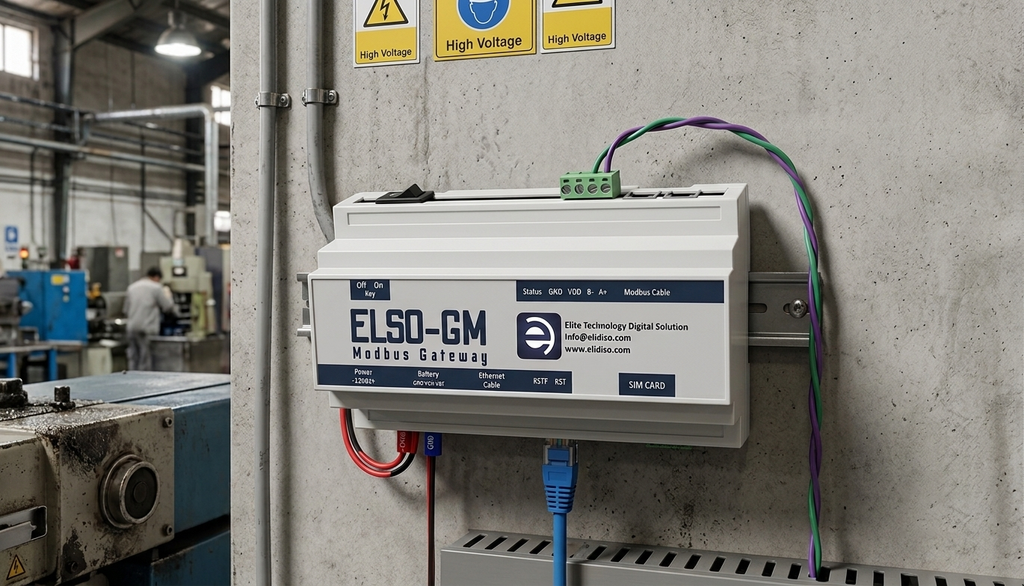
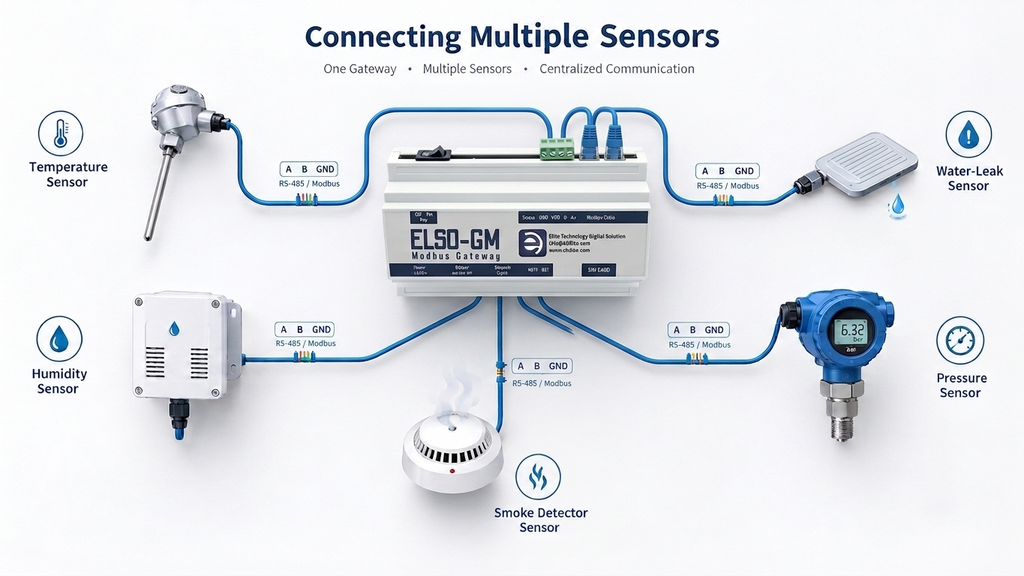
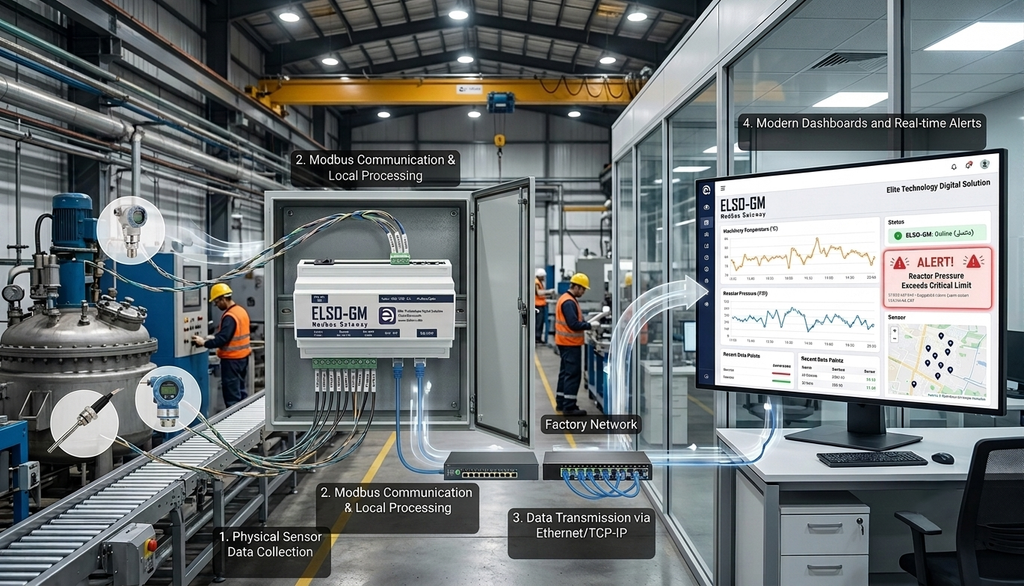
    A Modbus gateway collects data from multiple sensors on the bus by polling each one in sequence. It aggregates the readings and forwards them, which is typically over Ethernet or a cellular connection, to a central monitoring platform. The gateway is the bridge between the field-level sensor network and the digital management layer above it.

    A single gateway can typically handle dozens of sensors, making it cost-effective to instrument large facilities without running separate wiring or communication infrastructure for each device.

    Layer 3 — EMS / Monitoring Software

    The Energy Management System (EMS) or monitoring software receives data from the gateway, stores it, visualizes it in dashboards, generates alerts when readings exceed defined thresholds, and produces reports for compliance, auditing, or operational review.

    This three-layer architecture, sensors, gateway, software, is the core stack that Elidiso delivers as an integrated solution. All three components come from a single vendor, which means they are designed to work together, tested together, and supported together.

    Why Choose Modbus Over Other Protocols?

    There are many industrial communication protocols available today, including MQTT, BACnet, PROFIBUS, and OPC-UA; so why does Modbus remain so widely used? Several reasons:

    Universal compatibility

    Modbus is supported by virtually every industrial device on the market. If you are integrating sensors from multiple manufacturers into one system, Modbus is usually the lowest-friction option.

    Proven reliability

    Modbus RTU over RS-485 wiring is highly resistant to electrical noise and interference, a critical advantage in factories, power plants, and other electrically demanding environments where other communication methods struggle.

    Low complexity

    Modbus is straightforward to configure and troubleshoot. Unlike some newer protocols, it does not require complex middleware, licensing, or specialized expertise. This keeps installation and maintenance costs manageable.

    Long cable runs

    RS-485 wiring supports cable runs of up to 1,200 meters, making Modbus practical for large facilities where sensors are spread across significant distances.

    No vendor lock-in

    Because Modbus is an open standard, you are not tied to a single manufacturer’s ecosystem. Sensors, gateways, and software from different vendors can coexist on the same Modbus network, which gives procurement teams flexibility and negotiating leverage.

    What Are the Limitations of Modbus?

    A balanced evaluation requires acknowledging where Modbus has constraints:

    • Polling-based architecture — Data is collected when the gateway requests it, not pushed in real time. For most environmental monitoring applications, polling intervals of a few seconds are more than adequate. For applications requiring sub-second response, other protocols may be more suitable.
    • Limited native security — The original Modbus protocol was designed for closed industrial networks and does not include built-in encryption or authentication. When deployed over IP networks, additional network security measures are required.
    • Scalability ceiling — Very large networks with hundreds of sensors may require careful architecture to avoid polling bottlenecks. Gateway selection and network segmentation become important at scale.

    For the vast majority of industrial environmental monitoring applications, facilities management, energy monitoring, air quality, cold storage, cleanrooms, the Modbus sensor remains a manageable, well-understood, and proven choice.

    Who Uses Modbus Sensors?

    The Modbus sensor is used across a wide range of industries and applications, wherever reliable, wired environmental data collection is needed:

    • Manufacturing plants — Monitoring temperature, humidity, and air quality across production floors to protect product quality and worker safety
    • Data centers and server rooms — Tracking temperature and humidity to prevent equipment overheating and maintain uptime SLAs
    • Commercial buildings — HVAC monitoring, energy consumption tracking, and indoor air quality management
    • Pharmaceutical and food facilities — Environmental compliance monitoring for cleanrooms, cold storage, and regulated production areas
    • Infrastructure and utilities — Monitoring substations, water treatment facilities, and distribution networks

    Elidiso’s Modbus Sensor Solutions

    Elidiso’s core IoT monitoring product line is built on Modbus, specifically the ELSO.NMxx series of Modbus sensors, which measure environmental parameters including temperature, humidity, CO₂, air pressure, particulate matter, and light levels.

    Our sensors connect to Elidiso’s Modbus gateways and feed data directly into our EMS monitoring software, giving facility teams a complete, integrated view of their environmental conditions from a single platform, with no integration complexity and no multi-vendor troubleshooting.

    Key advantages of Elidiso’s Modbus sensor solutions:

    • Industrial-grade build quality for demanding environments
    • Flexible deployment — wall-mounted, duct-mounted, or panel-installed configurations
    • Scalable from a single room to a multi-building campus
    • Full integration between sensors, gateway, and EMS software — all from one supplier
    • Local technical support and after-sales service across the Middle East, Africa, and Europe

    Contact Elidiso today to discuss your facility’s environmental monitoring requirements and find out how the right Modbus sensor solution can give your operations the visibility and control they need.

  • What Is a Digital Twin? A Practical Guide for Industrial and Enterprise Teams

    What Is a Digital Twin? A Practical Guide for Industrial and Enterprise Teams

    Imagine being able to monitor, test, and optimize a piece of industrial equipment, or an entire factory, without ever touching the physical asset. That is exactly what digital twin technology makes possible. And in 2026, it has moved well beyond a buzzword: it is becoming a foundational tool for enterprises competing in an increasingly data-driven world.

    This guide explains what a digital twin is, how it works, where it is used, and why it matters for organizations operating in industrial, manufacturing, and infrastructure sectors.

    What Is a Digital Twin?

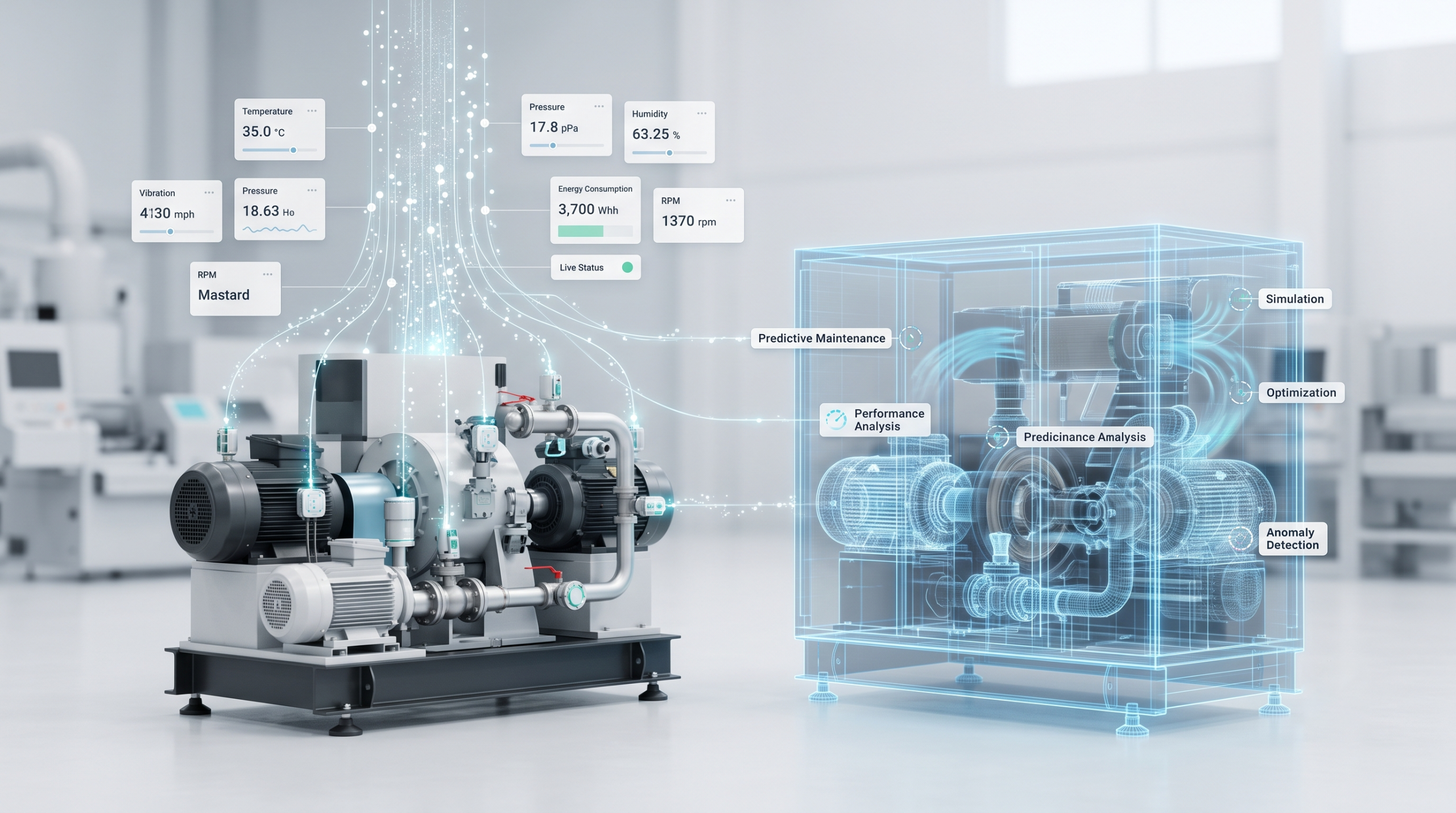
    A digital twin is a real-time virtual replica of a physical object, system, or process. It is continuously synchronized with its real-world counterpart through data from IoT sensors, and it mirrors the state, behavior, and performance of that asset in a digital environment.

    The concept was first introduced in manufacturing and aerospace, where engineers needed a way to simulate asset behavior without disrupting operations. Today, digital twins are used across industries ranging from smart cities and energy to logistics and healthcare.

    According to IBM, the digital twin market is expected to grow from USD 24.5 billion in 2025 to USD 259.3 billion by 2032, driven by rising demand for predictive intelligence and operational efficiency.

    How Does a Digital Twin Work?

    A digital twin system has three core components working together:

    1. The Physical Asset

    This is the real-world entity being modeled; a machine, a production line, a cold storage warehouse, a fleet of vehicles, or even an entire building. Sensors are attached to this asset to continuously capture data.

    2. The Data Layer

    IoT sensors collect real-time data on parameters such as temperature, pressure, vibration, speed, energy consumption, or location. This data is transmitted, typically via industrial protocols or cloud connectivity, to the digital model.

    3. The Digital Model

    The virtual model receives the live data feed and updates continuously to reflect the current state of the physical asset. Engineers and operators can interact with this model to monitor performance, run simulations, identify anomalies, and test changes, all without touching the real asset.

    What Can You Do With a Digital Twin?

    Digital twins unlock capabilities that traditional monitoring systems simply cannot offer:

    • Real-time monitoring — View the live status of assets from any location, with instant visibility into performance and anomalies.
    • Predictive maintenance: Detect early signs of equipment degradation before failures occur, reducing unplanned downtime and maintenance costs.
    • Simulation and testing: Model the impact of changes, new configurations, or stress conditions in the virtual environment before applying them to the real asset.
    • Process optimization: Identify bottlenecks, inefficiencies, and energy waste across entire production or logistics systems.
    • Root cause analysis: Replay historical data to understand why a failure occurred and how to prevent recurrence.

    Enterprises that deploy digital twins consistently report strong returns. A 2025 Hexagon survey found that 92% of companies using digital twins report returns above 10%, with more than half reporting a return on investment of at least 20%.

    Digital Twins in Industrial IoT

    The connection between digital twins and Industrial IoT (IIoT) is fundamental. Without IoT sensors providing continuous data, a digital twin would be a static model, useful for design, but not for operations. It is the live data stream from connected devices that transforms a model into a dynamic, intelligent replica.
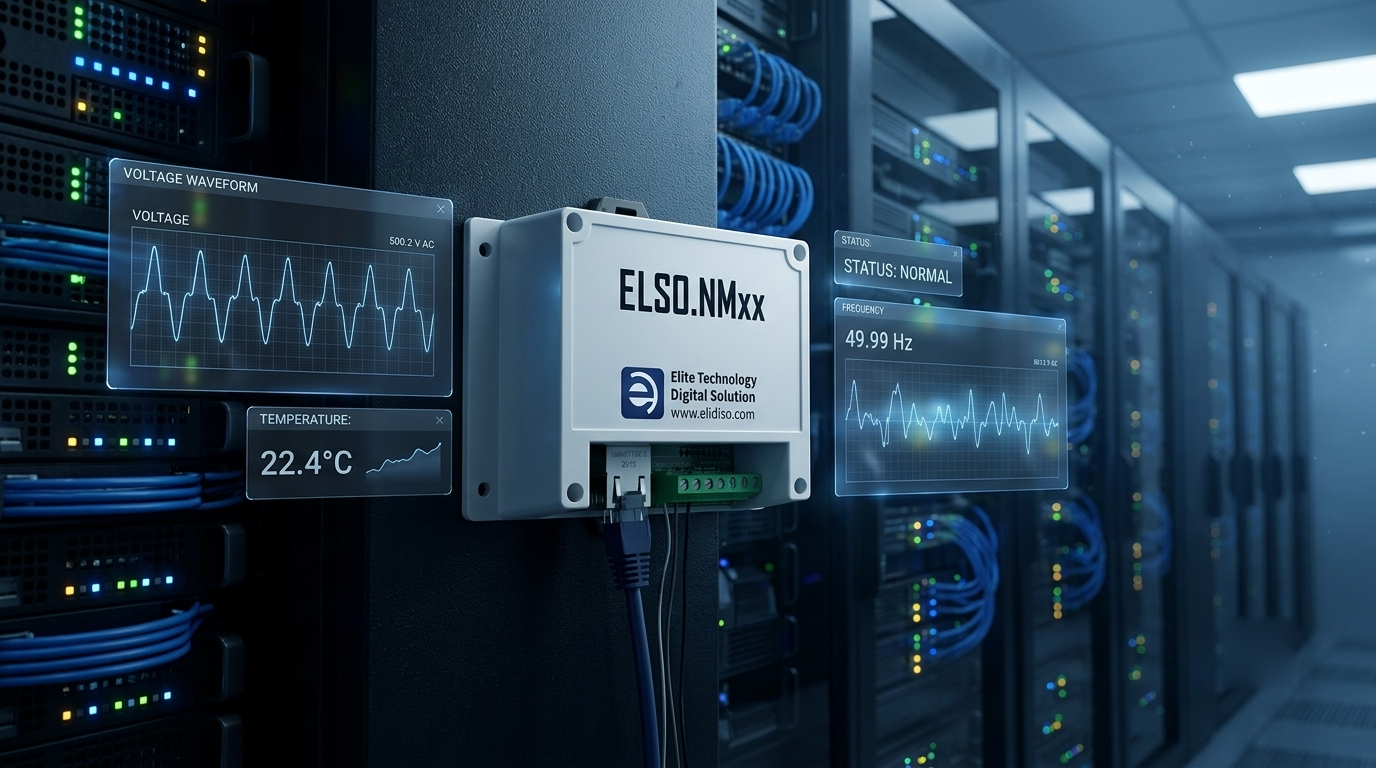
    In an IIoT environment, digital twins act as a convergence layer between raw sensor data and higher-level analytics and decision-making. They do not just show what is happening. In fact, they explain why it is happening and help predict what will happen next.

    Key industrial applications include:

    • Manufacturing — Monitoring production lines for quality deviations, energy inefficiency, and equipment wear.
    • Oil and gas — Simulating pipeline conditions and predicting corrosion or pressure failures.
    • Energy — Managing wind turbines, solar arrays, or power grid infrastructure in real time.
    • Logistics — Tracking assets such as forklifts, containers, or refrigerated vehicles across a supply chain.
    • Smart buildings — Optimizing energy consumption, HVAC performance, and occupancy management.

    Digital Twins and Industry 4.0

    Digital twins are widely recognized as one of the core enabling technologies of Industry 4.0, the fourth industrial revolution characterized by cyber-physical systems, smart automation, and data-driven decision-making.

    In a fully connected Industry 4.0 environment, individual digital twins do not operate in isolation. They form networks, communicating with each other, sharing insights, and collectively optimizing an entire ecosystem of assets and processes. This cooperative intelligence is what separates modern digital twin deployments from earlier monitoring systems.

    What Should You Look for in a Digital Twin Solution?

    For industrial and enterprise teams evaluating digital twin technology, the key selection criteria are:

    • Sensor compatibility — Can the platform integrate with your existing IoT hardware and industrial protocols such as Modbus or MQTT?
    • Real-time data throughput — Can it handle your data volume without latency that would compromise operational decisions?
    • Simulation capability — Does it support scenario modeling, not just live monitoring?
    • Scalability — Can it grow from monitoring a single machine to an entire facility or fleet?
    • Integration with existing systems — Does it connect to your ERP, SCADA, or cloud infrastructure?

    How Elidiso Supports Digital Twin Deployments

    At Elidiso, our IoT environmental monitoring solutions provide the sensor infrastructure and connectivity layer that digital twin platforms depend on. Our industrial-grade sensors capture the real-time data streams, temperature, humidity, pressure, air quality, and more, that feed the virtual models and make them accurate, actionable, and trustworthy.

    Whether you are building a digital twin for a single piece of critical equipment or an entire industrial facility, Elidiso’s monitoring hardware and connectivity solutions give you the data foundation you need. Contact our team to discuss how our IoT solutions can support your digital twin strategy.

  • Cold Chain Monitoring with IoT: How Smart Sensors Are Protecting Sensitive Cargo

    Cold Chain Monitoring with IoT: How Smart Sensors Are Protecting Sensitive Cargo

    One four-hour temperature excursion inside a refrigerated truck can destroy an entire pallet of pharmaceuticals, ruin a shipment of fresh produce, or trigger a regulatory non-compliance incident worth far more than the cargo itself. For industries that depend on the integrity of temperature-sensitive products, the cold chain is not just a logistics function, it is a business-critical risk.

    IoT technology is transforming how organizations monitor and manage that risk. In this article, we explore how smart sensors and real-time monitoring platforms are reshaping cold chain operations and what logistics, food, and pharmaceutical teams need to know.

    What Is Cold Chain Monitoring?

    Cold chain monitoring is the continuous tracking of environmental conditions, primarily temperature and humidity, throughout the storage and transportation of perishable or temperature-sensitive goods. The goal is to ensure products remain within their required temperature range from origin to final destination, without any gaps in visibility or control.

    Traditionally, this was done through manual logging and periodic checks. Today, IoT-enabled systems make it possible to monitor every stage of the cold chain in real time, from a warehouse shelf to a last-mile delivery vehicle.

    Why Cold Chain Failures Are Costly

    The numbers are significant. Temperature excursions account for approximately 14% of product losses in temperature-sensitive logistics globally. In the pharmaceutical sector, where even a brief deviation can render a batch non-compliant, the financial and regulatory consequences are far larger than the product value alone.

    On a broader scale, the UN Food and Agriculture Organization estimates that 526 million tonnes of food are lost or wasted every year partly due to insufficient refrigeration. For businesses, this translates directly into insurance claims, customer complaints, regulatory investigations, and damaged reputation.

    The global cold chain logistics market reached approximately $436 billion in 2025 and is forecast to grow to over $1.3 trillion by 2034 at a CAGR above 13%. As the market grows, so do the compliance requirements to make real-time monitoring not just a competitive advantage but an operational necessity.

    How IoT Transforms Cold Chain Monitoring

    IoT cold chain monitoring systems replace reactive, retrospective monitoring with continuous, proactive visibility. Here is how the technology works:

    Sensor Layer

    Calibrated temperature and humidity sensors are placed inside storage units, refrigerated vehicles, warehouses, and shipping containers. These sensors capture readings at configurable intervals, often every few seconds, and transmit data in real time.

    Connectivity Layer

    Modern cold chain IoT systems support multiple connectivity options to ensure no blind spots during transit:

    • 4G/5G cellular — Primary connectivity for vehicles and urban routes
    • NB-IoT / LTE-M — Low-power wide-area options for long-duration monitoring with extended battery life
    • Satellite — Backup connectivity for remote routes or ocean freight
    • Bluetooth gateways — Local data collection in warehouses and distribution centers

    Platform and Analytics Layer

    Cloud-based cold chain management platforms aggregate sensor data into centralized dashboards. Operators receive real-time alerts when readings exceed defined thresholds, enabling immediate corrective action before products are compromised. AI-powered analytics go further, identifying patterns, predicting equipment failures, and flagging high-risk routes before excursions occur.

    By 2026, over 71% of commercial cold chain facilities globally operate real-time temperature monitoring systems, and cloud-based cold chain management software has reached 55% market penetration.

    Key Parameters to Monitor Beyond Temperature

    Temperature is the primary concern, but a comprehensive cold chain monitoring system should also track:

    • Humidity: Critical for fresh produce, certain pharmaceuticals, and biological materials
    • Door open/close events: An open refrigerator door for even a few minutes can cause temperature spikes that compromise entire loads
    • Location and GPS tracking: Full visibility over vehicle position, estimated arrival times, and route adherence
    • Shock and vibration: Important for fragile pharmaceutical packaging or sensitive electronic components
    • Light exposure: Relevant for light-sensitive medications and biological samples

    Industry Applications

    Food and Beverage

    Fresh produce, dairy, seafood, and frozen goods all require precise temperature control throughout the supply chain. IoT monitoring enables producers, distributors, and retailers to detect excursions immediately, generate audit-ready compliance records, and reduce spoilage. Fleets deploying smart cold chain monitoring are cutting product loss by up to 30% compared to traditional manual operations.
    Pharmaceuticals and Healthcare

    The pharmaceutical cold chain is the most demanding environment for monitoring. mRNA vaccines, biologics, and clinical trial materials require ultra-cold storage with zero tolerance for deviations. IoT systems provide the continuous, automated documentation required under GDP guidelines, FDA 21 CFR Part 11, and WHO cold chain standards.

    Logistics and Distribution

    Third-party logistics (3PL) providers managing cold chain on behalf of multiple clients need platform-level visibility across entire fleets and warehouse networks. IoT monitoring systems with multi-client dashboards make it possible to manage compliance, SLAs, and reporting across complex, multi-stakeholder supply chains.

    What to Look for in a Cold Chain IoT Monitoring Solution

    When evaluating IoT cold chain solutions, logistics and operations teams should consider:

    • Sensor accuracy: Look for calibrated sensors with documented accuracy (±0.5°C or better for pharmaceutical applications)
    • Connectivity resilience: Multi-protocol support ensures continuous data flow even in low-coverage areas
    • Real-time alerting: Configurable threshold alerts by cargo type, not just one-size-fits-all notifications
    • Audit trail generation: Automated compliance documentation reduces manual reporting burden
    • Scalability: The system should handle growth from a single vehicle to a full fleet and warehouse network
    • Integration: Compatibility with existing ERP, WMS, or fleet management platforms

    How Elidiso Supports Cold Chain Operations

    Elidiso’s IoT environmental monitoring solutions include industrial-grade temperature and humidity sensors designed for demanding logistics and storage environments. Our hardware supports multiple connectivity protocols and integrates with leading cold chain management platforms, giving your team real-time visibility, automated alerts, and the compliance documentation your operations require.

    From pharmaceutical warehouses and food distribution centers to refrigerated transport fleets, Elidiso provides the monitoring infrastructure that keeps your cold chain under control.

    Contact Elidiso today to discuss your cold chain monitoring requirements and receive a solution tailored to your operations.
  • Enterprise ID Card Printing: A Complete Guide for HR and Admin Teams

    Enterprise ID Card Printing: A Complete Guide for HR and Admin Teams

    Every day, employees walk through doors, clock into shifts, and access secure systems using one small credential: their ID card. For HR and admin teams at growing enterprises, managing a professional, secure, and efficient ID card printing program is more than a convenience, it is a critical part of workplace security and operational continuity.

    Whether you are setting up an ID issuance program from scratch or upgrading an outdated system, this guide covers everything you need to know, from choosing the right card printer to best practices for in-house badge issuance.

    Why Enterprise ID Card Printing Matters

    Employee ID cards serve a wide range of functions that go far beyond simple identification. In a corporate environment, a well-designed badge system can:

    • Control physical access to buildings, floors, and restricted zones
    • Track time and attendance automatically when integrated with HR software
    • Enable cashless payments in canteens or vending machines
    • Provide logical access to IT networks and workstations
    • Reinforce brand identity and a professional organizational culture

    For HR and admin teams, the challenge is not just what to print, but how to manage the entire lifecycle of a credential, from onboarding to offboarding.

    In-House vs. Outsourced Printing: Which Is Right for You?

    One of the first decisions HR teams face is whether to print ID cards in-house or outsource the process. Each approach has clear trade-offs.

    In-House Printing

    With a dedicated card printer on-site, your team can issue badges instantly, ideal for new hires, lost card replacements, or temporary visitor passes. In-house printing also keeps sensitive employee data within your organization and eliminates the per-card fees charged by external vendors.

    On average, outsourcing ID badge printing costs $6–8 per card, while in-house printing can reduce that cost to $0.35–0.45 per card, a significant saving at enterprise scale.

    Outsourced Printing

    For organizations with very low issuance volumes, or those without the IT resources to manage a printer, outsourcing can simplify operations. The trade-off is slower turnaround and higher per-card cost. It is also less suitable for organizations that frequently issue temporary or visitor badges.

    Recommendation: For most mid-to-large enterprises, in-house printing with a quality card printer and integrated issuance software provides the best balance of cost efficiency, security, and agility.

    Choosing the Right ID Card Printer for Your Enterprise

    Not all card printers are built for enterprise environments. When evaluating options, HR and admin teams should consider the following key factors:

    1. Print Volume and Speed

    Entry-level printers can handle up to 500 cards per year. Mid-range models print 120–150 full-color cards per hour, while enterprise-grade printers can produce 30,000+ cards annually at 230 cards per hour. Match your printer to your actual issuance needs — both today and for projected growth.

    2. Print Technology: DTC vs. Retransfer

    Direct-to-Card (DTC) printing applies ink directly to the card surface. It is fast, cost-effective, and ideal for standard employee photo ID badges at 300 dpi resolution. However, DTC printers leave a small white border around the card edge.

    Retransfer (HDP) printing first prints onto a clear film that is then thermally fused over the entire card surface. This delivers edge-to-edge, photo-quality output and works better on cards with embedded chips or contactless technology. Retransfer cards are also inherently more tamper-evident, any attempt to separate the layers destroys the image.

    For enterprises with high security requirements or smart card encoding needs, retransfer printing is the recommended choice.

    3. Encoding Capabilities

    Modern enterprise ID cards are often multi-functional. Your card printer should support encoding options such as:

    • Magnetic stripe — for legacy access systems and time-tracking
    • Contact smart card — for secure logical access and cryptographic functions
    • Contactless (RFID/NFC) — for tap-and-go access control and mobile credentialing
    • Barcode — for inventory, canteen, or visitor management integration

    Choosing a printer with modular encoding options means you can expand capabilities as your security needs evolve, without replacing your hardware investment.

    4. Security Features

    Enterprise environments require printers that support:

    • Locked card input hoppers to prevent unauthorized access to blank card stock
    • Secure Boot firmware verification to prevent tampering
    • User authentication and audit logging within the print software
    • Holographic overlaminates and UV printing for counterfeit prevention

    5. Software Integration

    Your card printer should integrate seamlessly with your HR database, access control platform, or identity management system. Modern issuance platforms can capture photos via mobile devices, submit cards to a print queue, and automatically activate credentials upon printing, eliminating the multi-step manual workflows that slow down HR teams.

    Card Types: What Material Should You Choose?

    The physical card material affects durability, security, and overall card lifespan. Here is a quick overview:

    • PVC cards — The industry standard for most organizations. Lightweight, affordable, and easy to print. Best for standard employee IDs with moderate daily use.

    • Composite cards (PVC/PET) — More durable than standard PVC, typically lasting 3–4 years. Suitable for staff in demanding environments such as healthcare, manufacturing, or transit.
    • Polycarbonate cards — The highest-security option, used in government IDs and high-assurance enterprise credentials. Laser-engraved data is embedded within the card layers, making them extremely tamper-resistant.

    Best Practices for an Enterprise ID Card Issuance Program

    Even with the right hardware, a poorly managed issuance program creates security gaps. Here are the best practices HR and admin teams should follow:

    Establish a Formal Badge Policy

    Define clear rules covering who issues badges, what information appears on each card type (employee vs. contractor vs. visitor), how lost or stolen cards are reported and deactivated, and when cards must be returned (e.g., offboarding).

    Train Staff on Proper Badge Usage

    Issuing a card is only the beginning. Employees must understand the importance of not sharing credentials, reporting lost badges immediately, and following access control policies. A brief onboarding session on badge usage reduces security incidents significantly.

    Conduct Regular Audits and Updates

    Enterprise card programs should be audited at regular intervals, typically quarterly or annually, to deactivate expired credentials, update employee photos, and verify that the issuance system is functioning correctly.

    Plan for Instant Issuance Scenarios

    Not all badges can be scheduled in advance. Visitor passes, contractor credentials, and lost card replacements all require immediate issuance capability. Ensure your setup includes a desktop printer or self-service issuance terminal that allows on-demand printing without depending on a central batch process.

    Consider a Centralized vs. Distributed Issuance Model

    Larger enterprises with multiple sites may benefit from a combination of centralized badge management software and distributed printers at each location. This allows corporate IT to maintain control over templates and data, while local HR teams handle physical issuance.

    How Elidiso Supports Enterprise ID Card Programs

    At Elidiso, we supply and support a range of professional card printing solutions from leading brands including Matica, Fargo (HID), and Zebra, covering everything from compact desktop printers for small HR teams to high-throughput systems for large-scale enterprise issuance.

    Our solutions are backed by:

    • Expert consultation to match the right printer to your volume, security, and integration needs
    • A full range of consumables, ribbons, overlaminates, and blank card stock, to keep your program running without interruption
    • Software integration support to connect card issuance with your existing HR and access control platforms
    • After-sales technical support and maintenance services

    Whether you are issuing 500 cards a year or 50,000, Elidiso has the hardware, consumables, and expertise to build a reliable, secure enterprise ID card program. Contact our team today to discuss your requirements and receive a tailored recommendation.

    Final Thoughts

    Enterprise ID card printing is not simply an HR administrative task, it is a cornerstone of workplace security, operational efficiency, and professional identity. By choosing the right printer, adopting best-practice issuance workflows, and partnering with a reliable supplier, HR and admin teams can build a badge program that grows alongside the organization and adapts to its evolving security needs.

    Investing in the right system today prevents the operational headaches of a fragmented, reactive approach tomorrow.

  • Energy and Utility Monitoring: Why Operators Can’t Afford Blind Spots Anymore

    Energy and Utility Monitoring: Why Operators Can’t Afford Blind Spots Anymore

    Energy and utility monitoring exists to catch a specific kind of risk: failures that don’t happen all at once. Power distribution and utility infrastructure rarely fail in a single dramatic event. They fail in small, measurable steps first, a voltage fluctuation lasting a few seconds, a load imbalance that grows slightly worse every week, a piece of equipment running a few degrees warmer than it should. Individually, none of these looks urgent. Together, over weeks or months, they’re often the early signature of a failure that eventually becomes urgent, expensive, and very public.

    Energy and utility systems carry a different category of risk than most monitored industries. A factory line going down affects one facility. A substation or distribution fault can affect a neighborhood, a hospital, and a water treatment plant at the same time. For utility operators, the margin for “we’ll catch it next time someone checks” is smaller than almost anywhere else.

    What Is Energy and Utility Monitoring?

    Energy and utility monitoring is the continuous tracking of power distribution, load conditions, and the physical and environmental status of utility assets, often across multiple sites, using sensors, gateways, and centralized software instead of periodic manual inspection. Unlike a smart meter, which only reports consumption, a full monitoring system tracks the operating conditions around that consumption: voltage and current fluctuations, equipment temperature, environmental conditions at remote sites, and the connectivity status of distributed assets like substations or pump stations.

    The Visibility Gap in Utility Infrastructure

    Most utility and energy operations already collect some data. Meters log consumption. SCADA systems track core operational parameters. The gap is rarely a total absence of data, it’s usually that the data lives in disconnected systems, gets reviewed on a delay, or only covers part of the operation.

    A few patterns show up repeatedly across utility infrastructure monitoring:

    • Power distribution and consumption are tracked, but voltage, current, and load fluctuations on individual circuits aren’t monitored closely enough to catch a developing problem before it trips a breaker or damages equipment.
    • Remote or unmanned sites, substations, pump stations, distributed generation assets, go unchecked for long stretches between physical visits, leaving the operator dependent on equipment simply not failing in the meantime.
    • Utility assets are managed locally, site by site, instead of through one system that gives operations teams a consistent view across the whole network.

    None of these gaps come from negligence. They come from infrastructure built and expanded over years, often decades, with monitoring added incrementally rather than designed in from the start.

    How Real-Time Energy Monitoring Works

    The shift from periodic checks to real-time energy monitoring isn’t really about collecting more data. It’s about collecting the right data constantly enough that a developing problem is visible while it’s still developing, not after it’s already caused an outage.

    For energy and utility environments specifically, that means:

    Power distribution and load monitoring

    Tracking voltage, current, and load conditions continuously, so fluctuations that precede equipment stress or failure are caught early, rather than discovered through a tripped breaker or a damaged transformer.

    Remote and distributed asset monitoring.

    Substations, pump stations, and generation sites don’t need to depend on scheduled physical visits to report status. Sensors and connected gateways report continuously, even from locations with limited local network infrastructure.

    Centralized operational visibility.

     Bringing utility assets across multiple sites into a single monitoring dashboard means an operations team isn’t reconstructing the full picture from separate local systems during an active incident. The picture already exists, and it’s already current.

    Threshold-based real-time alerts.

    Limits set for each parameter mean that when a reading moves outside an acceptable range, the responsible team is notified immediately, not at the next scheduled inspection.

    Elidiso’s Approach to Energy and Utility Monitoring

    This is the same underlying architecture Elidiso applies across industrial and environmental monitoring more broadly: sensors collecting environmental and operational data, a gateway connecting devices across distances and protocols (including Modbus RTU and Modbus TCP) without requiring a full infrastructure overhaul, and monitoring software that brings everything into one real-time dashboard, with historical data and alerting built in.

    For energy and utility operators, that architecture addresses a specific version of a problem every monitored industry faces, one we covered in more general terms in What Is Environmental Monitoring and Why Businesses Can’t Ignore It in 2026: the risk that matters most is rarely the one you’re already watching closely. It’s the one quietly developing somewhere you’re not.

    The Real Question for Utility Operators

    The technology to monitor distributed energy infrastructure continuously already exists and is already in use across the industry. The open question for most operators isn’t whether to adopt it, it’s how much of their current infrastructure is still depending on scheduled checks for an outcome that depends on continuous awareness instead.

    If a voltage fluctuation started on one of your remote assets right now, how long would it take your team to find out?

  • What Is Environmental Monitoring and Why Businesses Can’t Ignore It in 2026

    What Is Environmental Monitoring and Why Businesses Can’t Ignore It in 2026

    Environmental conditions influence operations more than many organizations realize.

    Small changes in temperature, humidity, air quality, or surrounding infrastructure conditions can gradually affect performance, increase maintenance requirements, and introduce avoidable operational risk. In many environments, these issues are difficult to detect until they become costly.

    Environmental monitoring helps solve this problem. By collecting and analyzing environmental data continuously, organizations gain visibility into conditions that influence equipment performance, operational continuity, and decision-making. Rather than relying on periodic inspections or delayed reporting, monitoring creates a more proactive operating model.

    Today, environmental monitoring is increasingly becoming part of operational strategy rather than a standalone technical function.

    How Environmental Monitoring Works

    At its core, environmental monitoring is the continuous observation of conditions within an operating environment. Sensors measure selected variables and transmit data into a centralized platform where information can be viewed, analyzed, and used to trigger alerts when conditions move outside defined thresholds.

    Modern systems are designed to do more than display data. They help organizations identify trends, detect anomalies earlier, and respond before environmental changes begin affecting performance.

    Depending on the environment, monitored variables commonly include:

    • Temperature
    • Humidity
    • Air quality
    • Infrastructure conditions
    • Environmental changes surrounding critical assets

    This creates a more complete understanding of operational conditions over time.

    Why Businesses Are Investing in Environmental Monitoring

    Operational environments are becoming more connected, more distributed, and more demanding. As a result, organizations are looking for better ways to improve reliability while reducing manual oversight.

    Environmental monitoring supports these goals in several ways. Continuous visibility allows teams to identify changes earlier instead of reacting after disruption occurs.

    Real-time information improves operational awareness and supports faster decision-making. Automated monitoring also creates consistency across locations and reduces dependence on manual processes.

    Over time, this approach helps organizations improve reliability while maintaining greater control over operational conditions.

    Where Environmental Monitoring Creates the Most Value

    Environmental monitoring is used across a wide range of environments because stable operating conditions directly influence outcomes.

    Data-intensive environments rely on monitoring to maintain continuity and reduce avoidable interruptions. Industrial and production facilities use monitoring to support consistency and maintain operational standards. Warehousing and logistics operations benefit from improved environmental visibility across locations.

    Commercial environments increasingly use monitoring to support more efficient building operations and long-term infrastructure performance. Although operational goals vary, the objective remains the same: create earlier visibility and reduce uncertainty.

    Choosing the Right Monitoring Approach

    Selecting an environmental monitoring solution should begin with operational requirements rather than technical specifications.

    Organizations should evaluate whether a solution can scale with future needs, integrate with existing systems, provide meaningful reporting, and support timely response. The most effective monitoring platforms are not necessarily the ones that collect the most data, they are the ones that turn information into decisions.

    Conclusion

    Environmental monitoring has moved beyond simple measurement. It now plays an increasingly important role in helping organizations improve visibility, reduce operational risk, and operate with greater confidence.

    As operational environments continue to evolve, the ability to understand conditions in real time becomes less of an advantage and more of an expectation. Businesses that build monitoring into their operating model position themselves to make faster decisions, improve reliability, and create stronger long-term performance.

  • The Future of Efficiency: Why Industrial IoT Solutions are Essential in 2026

    The Future of Efficiency: Why Industrial IoT Solutions are Essential in 2026

    In 2026, the industrial landscape is defined by a shift from simple automation to intelligent, self-correcting systems. As global infrastructure becomes more complex, businesses are turning to Industrial IoT solutions to bridge the gap between data collection and physical action. But what does this integration actually look like on the factory floor and in the server room?

    For many companies, the primary hurdle is “data blindness”, having thousands of disparate data points but no clear picture of operational health. Industrial IoT solutions act as the central nervous system of a facility, integrating environmental sensors, telecommunication circuits, and edge hardware to provide a real-time pulse on your assets.

    By implementing robust Industrial IoT solutions, firms can transition from reactive troubleshooting to proactive optimization. This shift is critical: when you can monitor environmental variables, such as humidity, vibration, and heat, you aren’t just reacting to failures; you are preventing them.

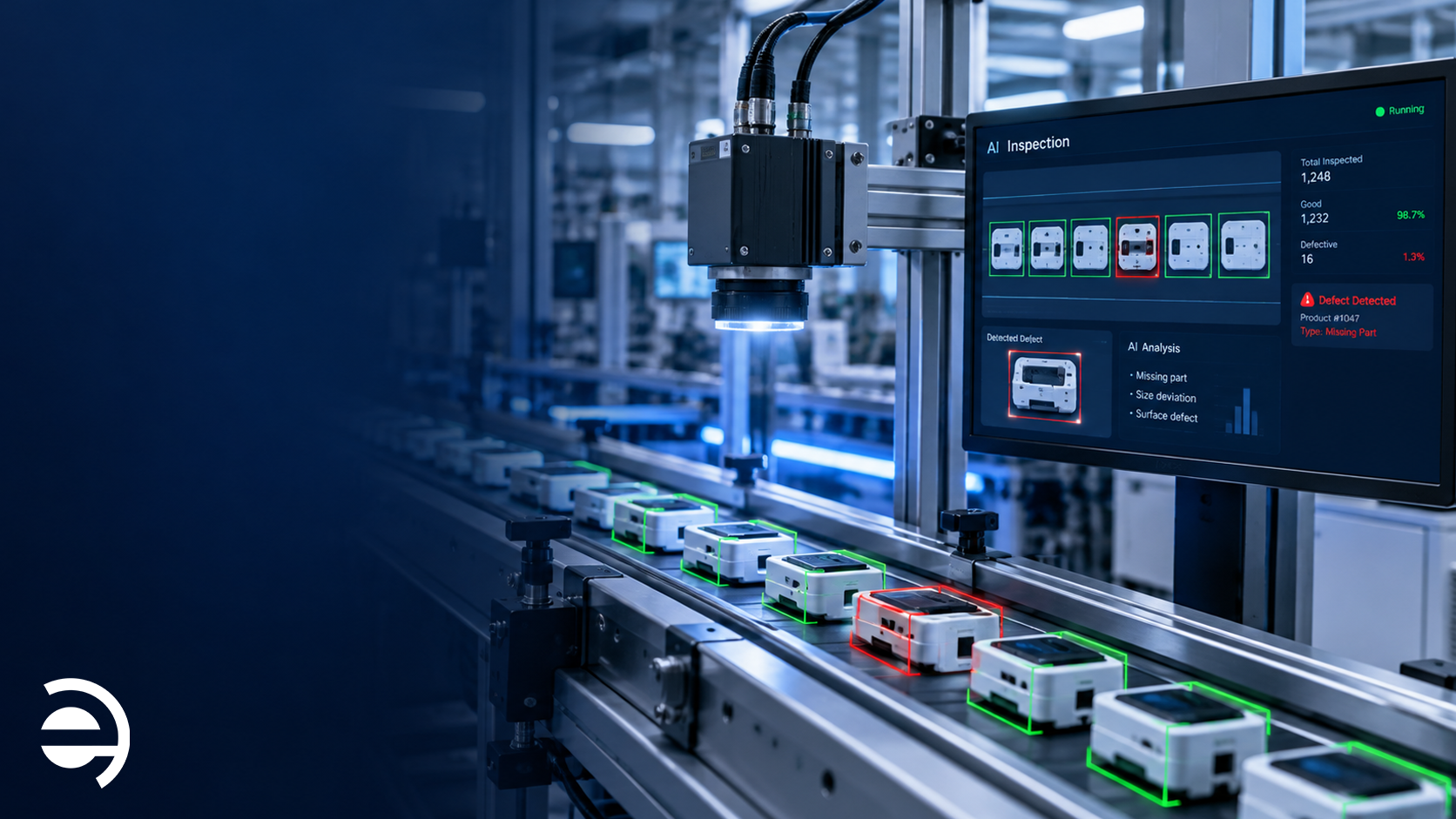
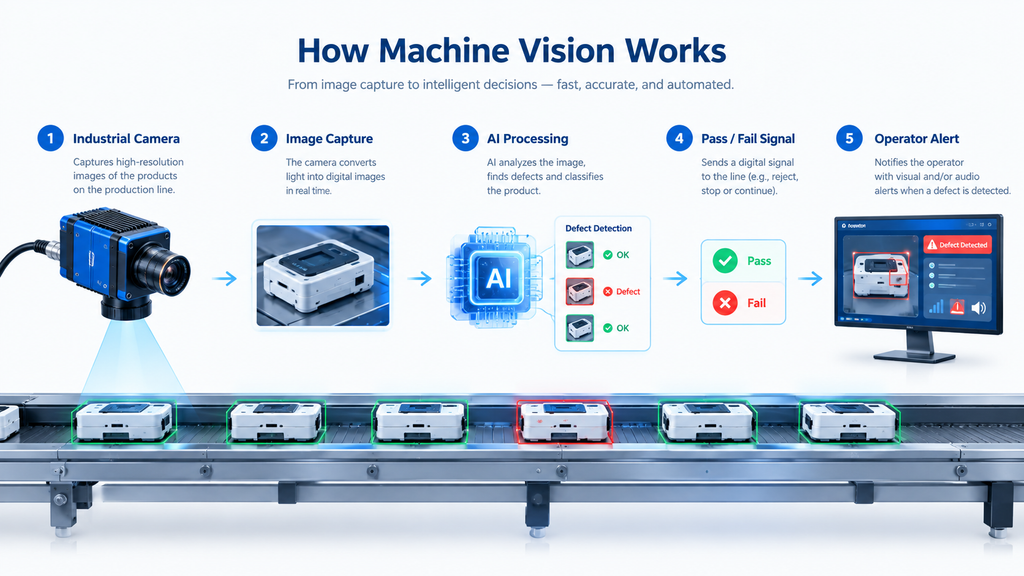
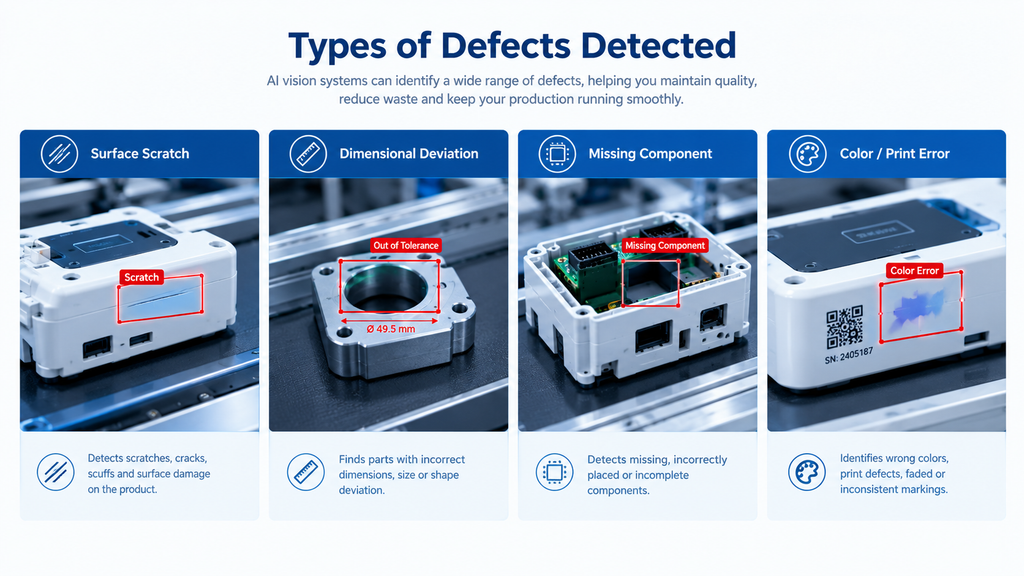
    Modern smart infrastructure requires more than just basic connectivity; it demands intelligence. Through AI-assisted monitoring, we can now process visual and sensor inputs simultaneously to identify anomalies that humans, or traditional rule-based software, would inevitably miss.

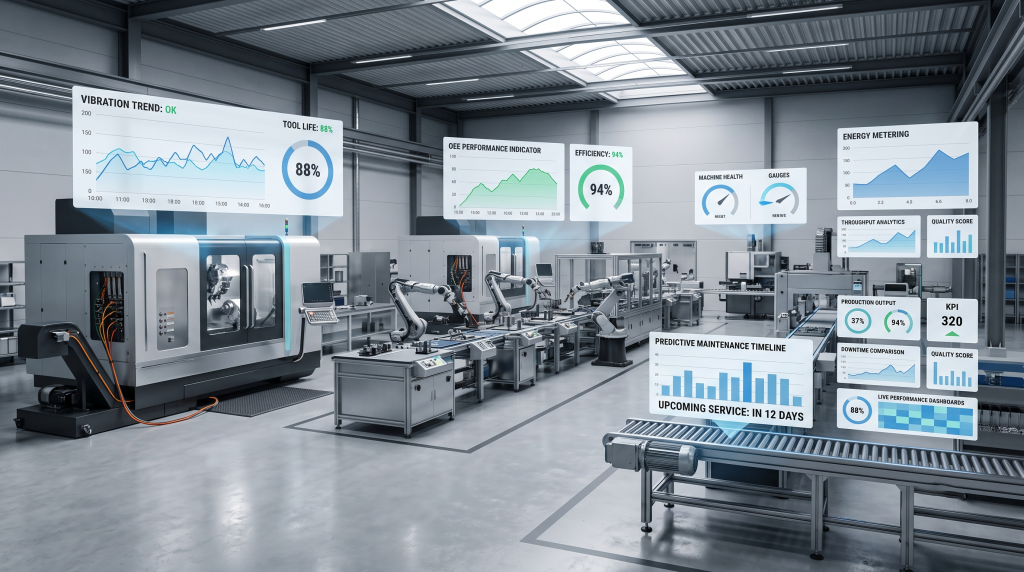
    • Predictive Maintenance: Utilize Industrial IoT solutions to detect subtle vibration or temperature fluctuations in critical machinery long before a catastrophic failure occurs.
    • Energy Optimization: Leverage data-driven insights to manage power loads dynamically. In data centers, this means reducing cooling costs by adjusting airflow based on real-time server activity.
    • Operational Scalability: Deploy modular sensor nodes that grow alongside your business. Whether you are managing one server rack or a global network of facilities, our systems scale to meet the demand.

    Centralized cloud processing is often hampered by latency and security concerns. By utilizing edge computing within your Industrial IoT solutions, processing happens locally.

    Why does this matter?

    1. Latency: Critical decisions, such as emergency shutdowns, happen in milliseconds, not seconds.
    2. Bandwidth: You are only sending actionable insights to the cloud, rather than massive streams of raw data, reducing network costs.
    3. Sovereignty: Your sensitive operational data stays within your local network, a key requirement for secure industrial environments.

    Integrating Industrial IoT solutions is not a “plug-and-play” task. It requires a deep understanding of the underlying electronics. At Elidiso, we approach this through the lens of telecommunication circuit design and industrial hardware reliability.

    From high-precision sensor nodes that function in harsh industrial conditions to the software layers that visualize that data, every component must be calibrated for long-term stability. When you choose an industrial-grade partner, you aren’t just buying hardware; you are investing in the longevity of your entire infrastructure.

    At Elidiso, we specialize in delivering tailored Industrial IoT solutions that address the unique needs of your physical environment. Whether you are hardening your server room infrastructure or deploying AI-driven image processing for quality control, our goal is to provide the reliability and transparency you need to stay competitive.

    As we move further into 2026, the question is no longer if you should digitize your physical assets, but how fast you can implement the right Industrial IoT solutions to secure your future.