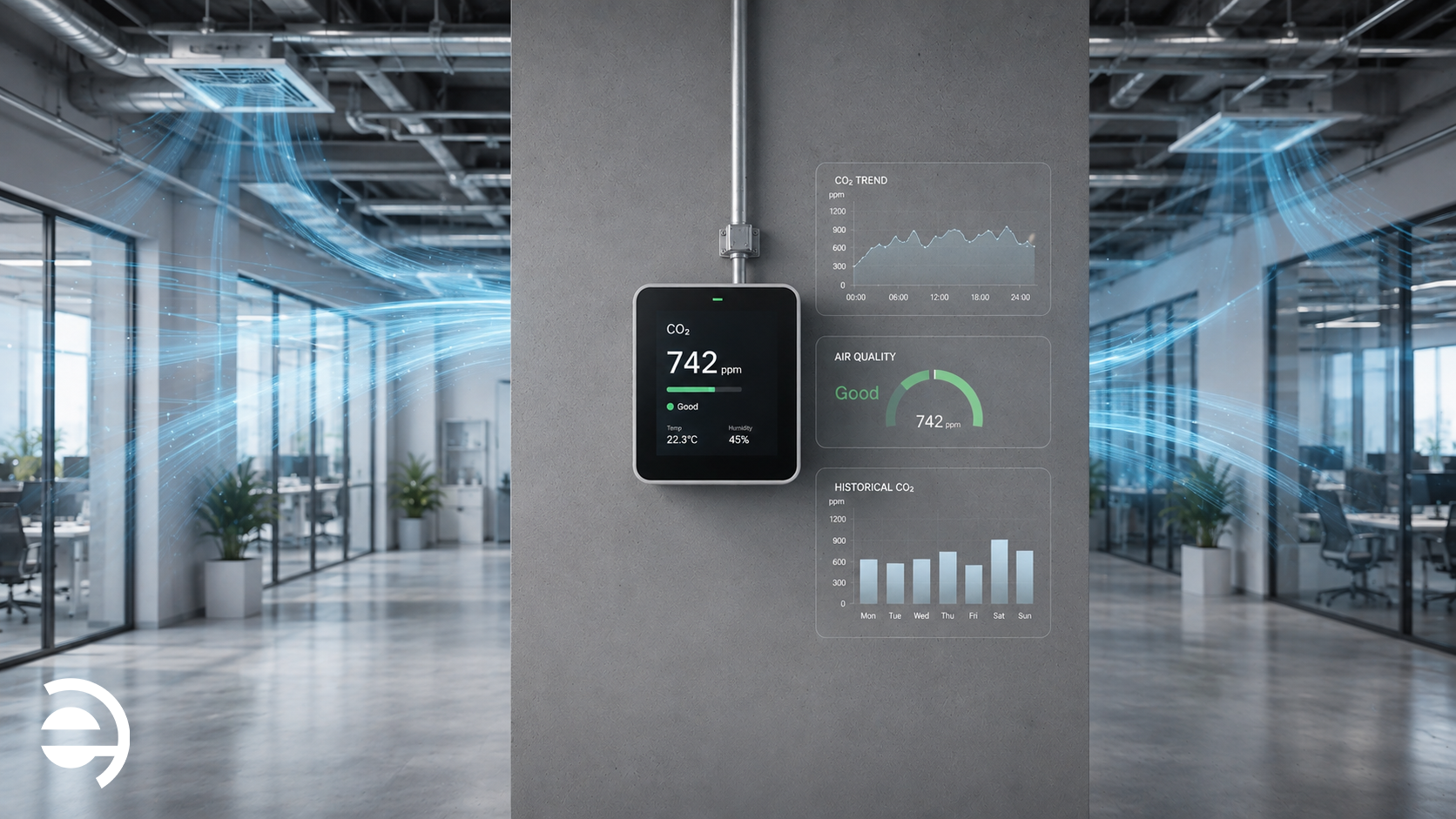
Indoor environments can change significantly throughout the day. As people enter a room, ventilation changes, doors open and close, and HVAC systems adjust, the quality of the air can change with them. Air quality monitoring makes it possible to observe these changes continuously rather than relying on occasional manual measurements.
Among the parameters used in indoor air quality monitoring, carbon dioxide (CO₂) is particularly useful. CO₂ sensors provide a measurable indication of how indoor conditions are changing and can help facility teams understand whether ventilation is keeping up with occupancy.
But what exactly does a CO₂ sensor measure, and how does it fit into an IoT monitoring system?
What Is Air Quality Monitoring IoT?
Air quality monitoring IoT refers to the use of connected sensors and monitoring platforms to continuously collect information about environmental conditions.
Instead of checking air quality manually at specific times, IoT-based monitoring can collect readings at regular intervals and make the data available through a centralized system.
Depending on the application, an air quality monitoring system may measure:
- CO₂ concentration
- Temperature
- Relative humidity
- Particulate matter such as PM2.5
- Air pressure
- Volatile organic compounds (VOCs)
- Other gases or environmental parameters
The value of IoT is not simply in measuring these parameters. It is in connecting the measurements so that changes can be observed over time, compared across spaces, and used to identify patterns.
What Does a CO₂ Sensor Measure?
A CO₂ sensor measures the concentration of carbon dioxide in the air, normally expressed in parts per million (ppm).
Carbon dioxide is naturally present in the atmosphere, but indoor concentrations can rise when people occupy an enclosed space. Humans continuously produce CO₂ through respiration, meaning occupied rooms can show noticeable changes in concentration when ventilation is insufficient relative to occupancy.
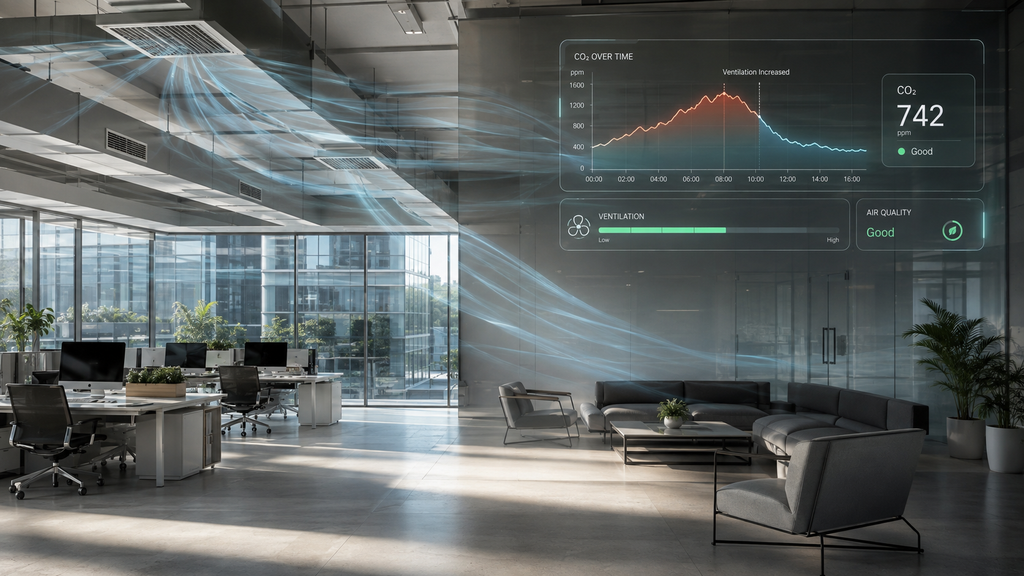
A CO₂ sensor therefore provides useful information about how indoor air conditions are changing.
How CO₂ Sensors Detect Carbon Dioxide
Many modern CO₂ sensors use non-dispersive infrared (NDIR) technology.
NDIR sensors work by detecting how infrared light is absorbed by CO₂ molecules. Because carbon dioxide absorbs infrared radiation at specific wavelengths, the sensor can estimate the concentration of CO₂ in the surrounding air.
This approach is widely used for indoor environmental monitoring because it provides continuous measurements without requiring chemical reagents.
The sensor then makes the measured value available to the monitoring system, where it can be recorded, visualized, and compared with configured thresholds.
Why Does CO₂ Matter for Indoor Air Quality?
CO₂ is not a complete measurement of indoor air quality. A room can have acceptable CO₂ levels while still containing other pollutants or contaminants.
However, CO₂ is a useful operational indicator because its concentration is strongly influenced by occupancy and ventilation.
When CO₂ levels repeatedly increase during occupied periods, facility teams can investigate whether:
- Ventilation is adequate for the number of occupants
- HVAC systems are operating as expected
- Air exchange is occurring effectively
- Certain rooms experience recurring ventilation problems
- Occupancy patterns are affecting indoor conditions
This makes CO₂ monitoring particularly useful in offices, classrooms, meeting rooms, healthcare facilities, commercial buildings, and other occupied spaces.
How Air Quality Monitoring IoT Turns CO₂ Data Into Useful Information
A standalone CO₂ sensor provides a reading. An IoT monitoring system provides context.
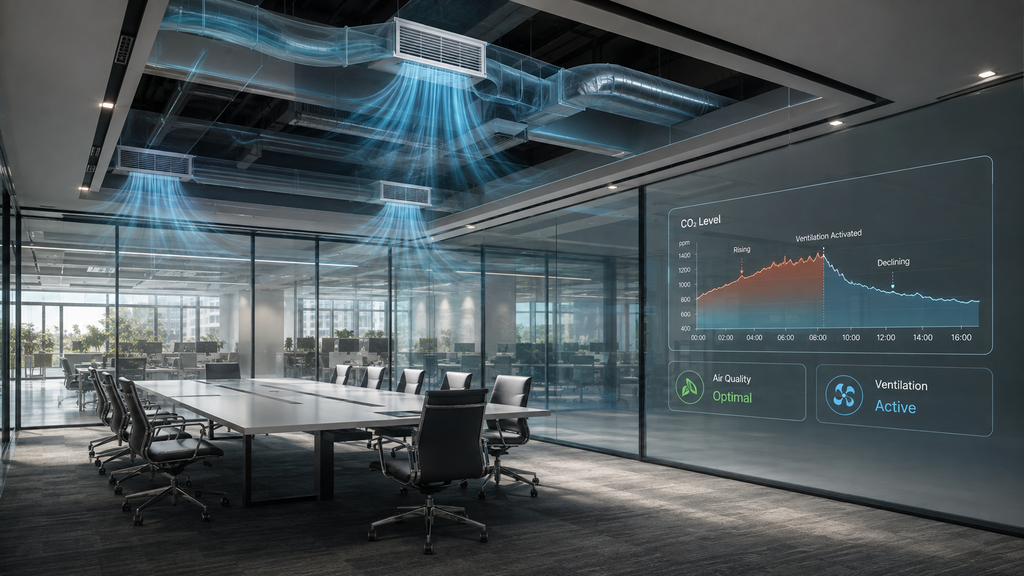
In a connected air quality monitoring system, the typical data flow includes three layers:
1. Sensor Layer
Sensors installed throughout a building measure CO₂ and other environmental parameters.
Measurements can be collected at defined intervals, creating a continuous record of changing conditions.
2. Connectivity Layer
The sensor communicates with a gateway or monitoring infrastructure using an appropriate communication protocol.
For industrial and building environments, protocols such as Modbus can provide a practical way to connect environmental sensors to a centralized system.
3. Monitoring Layer
The collected information is presented through software dashboards, historical charts, alerts, or reports.
This allows facility teams to move from isolated measurements to trends.
For example, instead of knowing that a meeting room currently has a certain CO₂ concentration, a monitoring platform can show how the concentration changed throughout the entire workday.
This distinction is one of the main advantages of air quality monitoring IoT.
What Can Continuous CO₂ Monitoring Reveal?
A single CO₂ reading provides limited information. Continuous monitoring creates a much clearer picture of how a space behaves.
For example, a monitoring system may reveal that:
- CO₂ consistently rises during afternoon meetings
- A particular office has higher readings than similar rooms
- Levels remain elevated after occupancy decreases
- Ventilation changes correspond with changes in CO₂
- Certain rooms experience recurring air quality patterns
- Environmental conditions vary significantly between different areas of the same building
These patterns can be difficult to identify through occasional manual measurements.
Continuous air quality monitoring IoT therefore supports a shift from reactive investigation to data-based observation.
CO₂ Monitoring and Building Operations
CO₂ data can also be useful when evaluating building operations.
HVAC systems are designed to maintain appropriate environmental conditions, but actual building performance can vary depending on occupancy, system configuration, maintenance, and usage.
When CO₂ measurements are combined with temperature and humidity data, facility teams can gain a broader understanding of indoor conditions.
For example, a building manager could compare:
- CO₂ levels with occupancy patterns
- CO₂ levels with HVAC schedules
- Temperature with ventilation changes
- Humidity with seasonal conditions
- Different rooms or zones over the same period
This does not mean that CO₂ alone determines whether a building has good or poor air quality. Instead, it provides another measurable data point for understanding how the building operates.
What Other Sensors Should Be Combined With CO₂?
A more complete indoor environmental monitoring strategy usually combines several parameters rather than relying on CO₂ alone.
Useful measurements may include:
Temperature
Temperature affects occupant comfort and can also help identify HVAC performance issues.
Humidity
Relative humidity can influence comfort, condensation risk, and the overall indoor environment.
Particulate Matter
PM2.5 and other particulate measurements can provide information about airborne particles that CO₂ sensors cannot detect.
VOCs and Other Gases
Depending on the building and application, additional gas sensors can help identify other potential sources of indoor air contamination.
Combining these measurements creates a more comprehensive environmental dataset than any single sensor can provide.
How to Choose a CO₂ Monitoring System
When selecting an IoT-based CO₂ monitoring solution, the sensor itself is only one part of the decision.

Consider the following factors:
- Measurement technology: Understand how the sensor detects CO₂ and the expected measurement range.
- Accuracy: Check the stated measurement accuracy and operating conditions.
- Sampling and update rate: Consider how frequently readings need to be collected.
- Communication protocol: Ensure compatibility with the existing monitoring architecture.
- Installation environment: Wall-mounted, duct-mounted, and other configurations may suit different applications.
- Data access: Confirm that measurements can be stored, visualized, and analyzed over time.
- Integration: Consider whether the system can connect with existing BMS, SCADA, EMS, or other platforms.
- Scalability: A suitable system should support expansion from one monitored room to multiple buildings or facilities.
For organizations already using industrial monitoring infrastructure, Modbus-based sensors can be particularly practical because environmental measurements can be integrated into a broader monitoring architecture. Elidiso’s existing guide on [what a Modbus sensor is and why it matters for industrial monitoring] can provide additional technical context.
Why Continuous Air Quality Monitoring Matters
Indoor air quality is dynamic. A building that appears well-ventilated in the morning may behave differently when occupancy increases later in the day.
Periodic measurements can provide useful snapshots, but continuous monitoring provides the timeline between those snapshots.
By using connected CO₂ sensors and other environmental sensors, organizations can:
- Observe indoor conditions continuously
- Identify recurring environmental patterns
- Investigate ventilation-related changes
- Compare different rooms or zones
- Build historical environmental records
- Support data-driven facility management
- Integrate environmental data with wider IoT monitoring systems
Ultimately, air quality monitoring IoT provides a way to turn invisible environmental changes into measurable data.
CO₂ sensors are not a complete solution for every aspect of indoor air quality, but they are an important component of a broader monitoring strategy. When connected to a reliable IoT architecture, their measurements can help facility teams understand how buildings actually operate and where environmental conditions may require closer attention.
For organizations developing connected environmental monitoring systems, Elidiso’s Modbus-based sensor architecture provides a way to bring parameters such as CO₂, temperature, humidity, and other environmental measurements into a centralized monitoring environment.
Leave a Reply