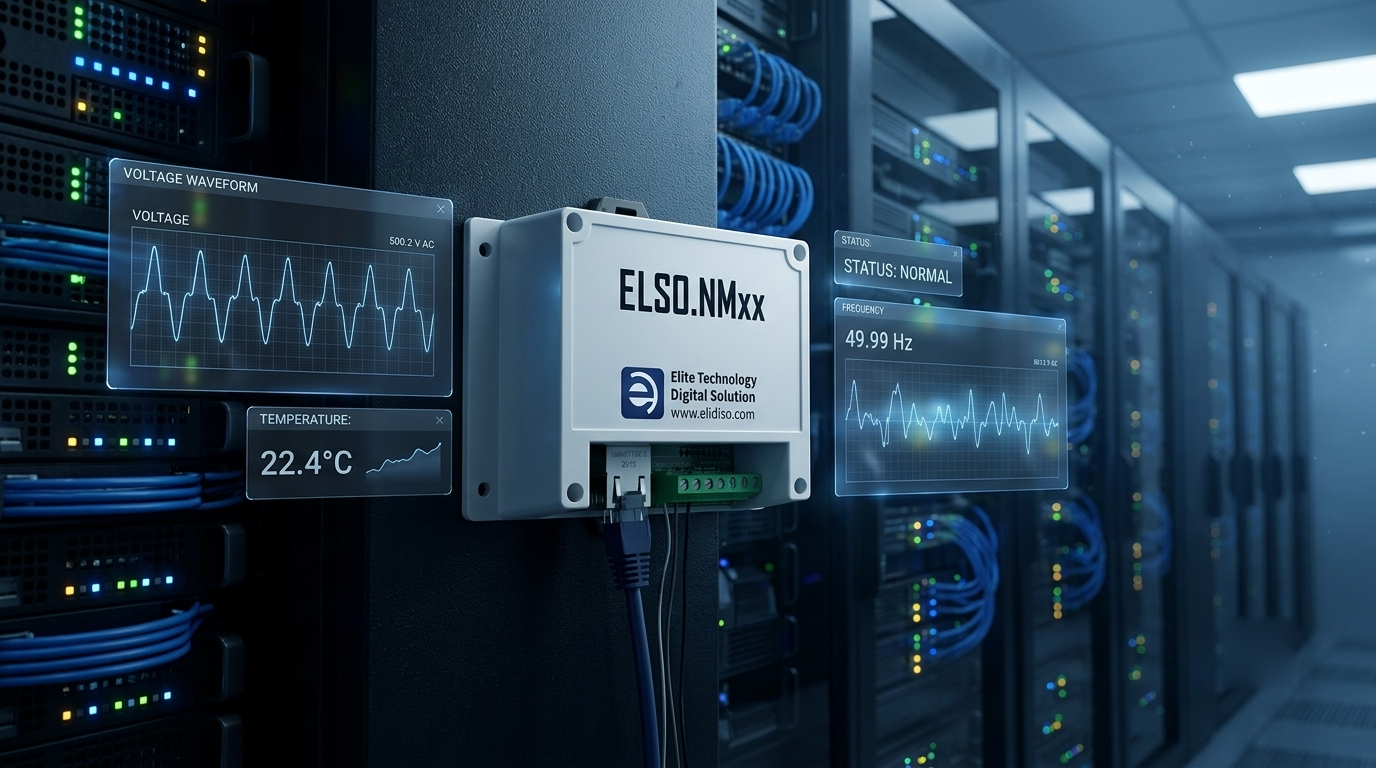
If you have ever explored industrial monitoring systems, you have almost certainly encountered the term Modbus sensor. It appears in product datasheets, system architecture diagrams, and procurement documents across manufacturing, energy, building management, and infrastructure sectors. But what does a Modbus sensor actually do and why does this technology still matter in 2026, decades after it was first introduced?
This guide explains Modbus in plain terms, what a Modbus sensor is, how it fits into a complete monitoring system, and what facility managers, engineers, and operations teams need to know when evaluating industrial IoT solutions.
What Is Modbus?
Modbus is a communication protocol which contains a set of rules that defines how devices exchange data with each other. It was developed in 1979 by Modicon for use in programmable logic controllers (PLCs), making it one of the oldest and most established protocols in industrial automation.
Despite its age, Modbus remains dominant in industrial environments for a simple reason: it works. It is robust, well-understood, vendor-neutral, and supported by virtually every industrial device manufacturer in the world. When engineers talk about industrial interoperability, Modbus is almost always part of the conversation.
There are two main variants in active use today:
- Modbus RTU — Communicates over serial wiring (RS-485 or RS-232). Compact, reliable, and well-suited to industrial environments where wired connections are practical. This is the most widely deployed variant.
- Modbus TCP — Communicates over standard Ethernet or IP networks. Easier to integrate into modern IT infrastructure and suitable for longer distances and more complex network topologies.
What Is a Modbus Sensor?
A Modbus sensor is an environmental or industrial sensor that communicates using the Modbus protocol. Rather than simply outputting a raw analog signal (like a voltage or current), a Modbus sensor transmits structured digital data that can be read, logged, and acted upon by a connected monitoring system.
Common parameters measured by Modbus sensors include:
- Temperature — Air, surface, liquid, or soil temperature
- Humidity — Relative humidity in ambient air or controlled environments
- CO₂ concentration — Indoor air quality monitoring in offices, warehouses, and industrial facilities
- Air pressure — Barometric or differential pressure for HVAC and cleanroom applications
- Particulate matter (PM2.5 / PM10) — Dust and air quality in industrial and urban environments
- Light levels — Illuminance monitoring for energy management and workplace compliance
- Voltage and current — Electrical monitoring for energy consumption tracking
Each sensor sits on a shared communication line, called a Modbus bus, and is assigned a unique address. When the master device (typically a gateway or controller) polls the bus, each sensor responds with its current reading. This polling architecture is simple, deterministic, and extremely reliable.
How Does a Modbus Sensor Fit Into a Monitoring System?
Understanding a Modbus sensor means understanding the system it sits within. A typical industrial environmental monitoring architecture has three layers:
Layer 1 — Sensors
Each Modbus sensor is deployed at the point of measurement, inside a factory, on an HVAC unit, in a server room, across a warehouse floor, or around a building perimeter. Each sensor continuously measures its parameter and holds the latest reading in memory until it is requested.
Layer 2 — Gateway
A Modbus gateway collects data from multiple sensors on the bus by polling each one in sequence. It aggregates the readings and forwards them, which is typically over Ethernet or a cellular connection, to a central monitoring platform. The gateway is the bridge between the field-level sensor network and the digital management layer above it.
A single gateway can typically handle dozens of sensors, making it cost-effective to instrument large facilities without running separate wiring or communication infrastructure for each device.
Layer 3 — EMS / Monitoring Software
The Energy Management System (EMS) or monitoring software receives data from the gateway, stores it, visualizes it in dashboards, generates alerts when readings exceed defined thresholds, and produces reports for compliance, auditing, or operational review.
This three-layer architecture, sensors, gateway, software, is the core stack that Elidiso delivers as an integrated solution. All three components come from a single vendor, which means they are designed to work together, tested together, and supported together.
Why Choose Modbus Over Other Protocols?
There are many industrial communication protocols available today, including MQTT, BACnet, PROFIBUS, and OPC-UA; so why does Modbus remain so widely used? Several reasons:
Universal compatibility
Modbus is supported by virtually every industrial device on the market. If you are integrating sensors from multiple manufacturers into one system, Modbus is usually the lowest-friction option.
Proven reliability
Modbus RTU over RS-485 wiring is highly resistant to electrical noise and interference, a critical advantage in factories, power plants, and other electrically demanding environments where other communication methods struggle.
Low complexity
Modbus is straightforward to configure and troubleshoot. Unlike some newer protocols, it does not require complex middleware, licensing, or specialized expertise. This keeps installation and maintenance costs manageable.
Long cable runs
RS-485 wiring supports cable runs of up to 1,200 meters, making Modbus practical for large facilities where sensors are spread across significant distances.
No vendor lock-in
Because Modbus is an open standard, you are not tied to a single manufacturer’s ecosystem. Sensors, gateways, and software from different vendors can coexist on the same Modbus network, which gives procurement teams flexibility and negotiating leverage.
What Are the Limitations of Modbus?
A balanced evaluation requires acknowledging where Modbus has constraints:
- Polling-based architecture — Data is collected when the gateway requests it, not pushed in real time. For most environmental monitoring applications, polling intervals of a few seconds are more than adequate. For applications requiring sub-second response, other protocols may be more suitable.
- Limited native security — The original Modbus protocol was designed for closed industrial networks and does not include built-in encryption or authentication. When deployed over IP networks, additional network security measures are required.
- Scalability ceiling — Very large networks with hundreds of sensors may require careful architecture to avoid polling bottlenecks. Gateway selection and network segmentation become important at scale.
For the vast majority of industrial environmental monitoring applications, facilities management, energy monitoring, air quality, cold storage, cleanrooms, the Modbus sensor remains a manageable, well-understood, and proven choice.
Who Uses Modbus Sensors?
The Modbus sensor is used across a wide range of industries and applications, wherever reliable, wired environmental data collection is needed:
- Manufacturing plants — Monitoring temperature, humidity, and air quality across production floors to protect product quality and worker safety
- Data centers and server rooms — Tracking temperature and humidity to prevent equipment overheating and maintain uptime SLAs
- Commercial buildings — HVAC monitoring, energy consumption tracking, and indoor air quality management
- Pharmaceutical and food facilities — Environmental compliance monitoring for cleanrooms, cold storage, and regulated production areas
- Infrastructure and utilities — Monitoring substations, water treatment facilities, and distribution networks
Elidiso’s Modbus Sensor Solutions
Elidiso’s core IoT monitoring product line is built on Modbus, specifically the ELSO.NMxx series of Modbus sensors, which measure environmental parameters including temperature, humidity, CO₂, air pressure, particulate matter, and light levels.
Our sensors connect to Elidiso’s Modbus gateways and feed data directly into our EMS monitoring software, giving facility teams a complete, integrated view of their environmental conditions from a single platform, with no integration complexity and no multi-vendor troubleshooting.
Key advantages of Elidiso’s Modbus sensor solutions:
- Industrial-grade build quality for demanding environments
- Flexible deployment — wall-mounted, duct-mounted, or panel-installed configurations
- Scalable from a single room to a multi-building campus
- Full integration between sensors, gateway, and EMS software — all from one supplier
- Local technical support and after-sales service across the Middle East, Africa, and Europe
Contact Elidiso today to discuss your facility’s environmental monitoring requirements and find out how the right Modbus sensor solution can give your operations the visibility and control they need.
Leave a Reply