
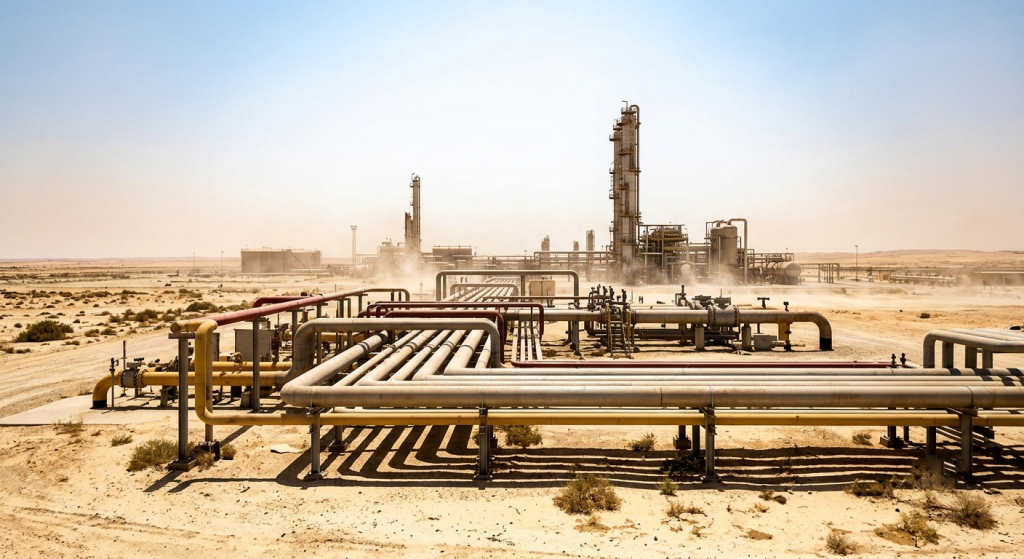
The Middle East is one of the most environmentally demanding operating regions in the world. Extreme heat, intense humidity along coastal zones, pervasive dust, and some of the highest industrial energy consumption rates globally create conditions that push facilities, equipment, and operations to their limits. For organizations which require managing factories, warehouses, data centers, logistics hubs, or commercial buildings across the GCC, environmental monitoring in the Middle East is not simply a best practice, but it is increasingly a regulatory requirement and a direct operational necessity.
For any organization with operations in the region, understanding the specific demands of environmental monitoring and Middle East conditions, from extreme heat and humidity to increasingly stringent regulatory requirements, is the foundation for building a resilient, compliant facility. This article examines the key environmental challenges, the regulatory landscape across Oman, UAE, and Saudi Arabia, and how industrial IoT solutions are helping organizations in Oman, the UAE, Saudi Arabia, and beyond gain the real-time visibility they need to protect assets, ensure compliance, and operate efficiently.
Why Environmental Monitoring in the Middle East Is Uniquely Challenging
Facilities in the GCC and broader Middle East face environmental conditions that are significantly more demanding than those in temperate regions. Understanding these challenges is the starting point for designing an effective environmental monitoring system.
Extreme Heat
Summer temperatures regularly exceed 45°C across the Arabian Peninsula, with ground-level and industrial surface temperatures often reaching 60–70°C. For sensitive equipment, electronics, HVAC systems, server infrastructure, and manufacturing machinery, sustained heat exposure accelerates degradation, increases failure rates, and drives up energy consumption. A robust remote monitoring system that tracks temperature continuously across all critical zones is the first line of defense against heat-related equipment failure.
High Humidity and Coastal Corrosion
Along the Gulf Coast, from Muscat to Dubai, Abu Dhabi, and Doha, relative humidity can exceed 90% during summer months. High moisture levels accelerate corrosion of metal components, degrade electrical insulation, promote mold growth in controlled environments, and compromise the accuracy of unprotected sensors. Facilities in coastal industrial zones must monitor humidity continuously to protect both assets and product quality.
Dust and Particulate Matter
Sandstorms and persistent airborne dust are a defining environmental challenge across the region, particularly in Oman, Saudi Arabia, and the UAE. Dust infiltration damages cooling systems, clogs filtration units, coats solar panels, and contaminates cleanrooms and pharmaceutical facilities. Air quality monitoring IoT sensors that track PM2.5 and PM10 particulate levels in real time give facilities early warning of dust events and enable automated responses before damage occurs.
Energy Consumption and Peak Load Pressure
The GCC has some of the highest per-capita energy consumption rates in the world, driven largely by cooling demand. As governments across the region push toward diversification and sustainability targets, UAE Net Zero 2050, Saudi Vision 2030’s energy efficiency components, Oman’s 2040 sustainability roadmap, facilities face growing pressure to monitor, report, and reduce energy consumption. Smart facility management platforms powered by IoT sensors are becoming the primary tool for meeting these obligations.
The Regulatory Landscape Driving Environmental Monitoring Demand

Regulation is now one of the primary drivers of environmental monitoring Middle East investment. The pace of legislative change across the GCC means organizations can no longer treat monitoring as optional and those that have not yet built a continuous environmental monitoring in the Middle East at a pace that was not seen five years ago. Organizations operating across the GCC now face binding compliance requirements that make continuous environmental monitoring not optional but mandatory.
UAE — Federal Environmental Law and GHG Reporting
The UAE passed Federal Decree-Law No. 11 on the Reduction of Climate Change Effects in August 2024, which took effect in May 2025. The law mandates that all public and private entities — including those in Free Zones report on their greenhouse gas emissions and submit emissions-reduction plans. Full compliance was required by May 2026, with penalties of up to AED 2 million for non-compliance. For industrial facilities, this makes continuous emissions and environmental monitoring a legal obligation.
Saudi Arabia — RCER-2025 and NCEC Reporting
Saudi Arabia’s Royal Commission Environmental Regulations (RCER-2025) significantly tightened environmental compliance requirements for industrial operators. Continuous Emissions Monitoring Systems (CEMS) are now mandatory for stacks above 2 MW thermal input, and hourly automated data transmission to the NCEC’s central platform is required, manual reporting is no longer accepted. Environmental permit applications are now fully digitalized, with processing times reduced by 40% through the NCEC platform.
Oman — MECA and Mandatory ESG Disclosure
Oman’s Ministry of Environment and Climate Affairs (MECA) governs environmental permitting and compliance for industrial facilities. Since January 2025, the Muscat Stock Exchange has mandated sustainability reporting for all listed companies, requiring disclosure against 30 GRI-aligned environmental, social, and governance metrics. For facilities operating in Oman’s industrial zones, Sohar, Duqm, Salalah, IoT solutions Oman that automate environmental data collection and reporting are increasingly essential for meeting these obligations efficiently.
GCC-Wide Air Quality Initiatives
In January 2025, the GCC launched a joint air quality monitoring network spanning 36 cities across the region, using real-time sensors and satellite data to track particulate matter and pollutants. This regional initiative signals a clear direction: governments across the Gulf are investing in environmental data infrastructure, and the expectation is that industrial facilities will follow with their own internal air quality monitoring IoT systems to align with national and regional standards.
How Industrial IoT Solutions Address Middle East Environmental Challenges
The growth of industrial IoT solutions in the Middle East reflects the scale of the environmental challenge. The Middle East and Africa IoT sensors market is projected to add USD 7.81 billion between 2026 and 2031, driven by government investment, multinational industrial participation, and the region’s accelerating digital transformation. The environmental sensor market in the Middle East and Africa alone is forecast to reach USD 222.7 million by 2034.
Modern environmental monitoring systems built on IoT technology address the region’s specific challenges through three core capabilities:
Real-Time Visibility Across All Parameters
Industrial IoT sensors deployed across a facility continuously measure the parameters that matter most in a Middle Eastern operating environment: temperature, humidity, CO₂ concentration, particulate matter (PM2.5/PM10), air pressure, light levels, and energy consumption. Data is transmitted in real time to a centralized remote monitoring system dashboard, giving operations teams instant visibility across every zone, from server rooms and cleanrooms to warehouse floors and outdoor equipment yards.
This real-time visibility eliminates the blind spots that manual monitoring creates and in a region where a two-hour temperature excursion can damage a batch of pharmaceuticals or trigger equipment failure, the ability to detect and respond immediately is not a luxury but an operational requirement.
Automated Alerting and Threshold Management
Effective environmental monitoring in the Middle East means the system does not just record data, it acts on it. IoT monitoring platforms allow operations teams to define threshold values for every parameter, triggering automated alerts, via SMS, email, or dashboard notification, when readings exceed acceptable ranges. During a sandstorm, for example, a sudden spike in PM10 readings triggers an alert to close ventilation intakes. A temperature anomaly in a server room triggers an immediate escalation before equipment reaches critical levels.
Compliance Documentation and Audit Trails
For facilities operating under UAE, Saudi, and Omani environmental regulations, the ability to generate audit-ready compliance reports is as important as the monitoring itself. Modern smart facility management platforms automatically log all sensor readings with timestamps, generate exception reports when thresholds are breached, and produce the structured data exports required for regulatory submission, eliminating the manual data collection burden that previously consumed significant time from operations and compliance teams.
Environmental Monitoring Middle East: Key Industry Applications
IoT solutions GCC deployments for environmental monitoring span a wide range of industrial and commercial sectors:
- Oil and gas facilities — Monitoring temperature, gas concentration, and air quality across upstream and downstream operations for both operational efficiency and HSE compliance
- Data centers — Continuous temperature and humidity monitoring to maintain uptime SLAs in facilities where cooling failure has immediate business impact
- Pharmaceutical and food production — Environmental compliance monitoring for cleanrooms, cold storage, and regulated production areas under GCC health authority requirements
- Logistics and warehousing — Temperature and humidity monitoring across large warehouse footprints, particularly for temperature-sensitive goods in transit or storage
- Commercial real estate and smart buildings — Energy monitoring, HVAC performance tracking, and indoor air quality management for mixed-use commercial developments
- Renewable energy — Performance and environmental monitoring for solar installations, where dust accumulation and temperature affect panel efficiency across the region’s rapidly expanding solar portfolio
Choosing an Environmental Monitoring Middle East Solution: What to Look For
Not all environmental monitoring systems are designed for the conditions found in the Middle East. When evaluating industrial IoT sensors and monitoring platforms for GCC deployment, operations and procurement teams should prioritize:
- Operating temperature range — Sensors must be rated for ambient temperatures of 55°C or above for outdoor or non-climate-controlled applications
- IP rating — IP65 or higher for dust and moisture resistance in industrial environments; IP67 or IP68 for outdoor coastal deployments
- Communication protocol reliability — Wired protocols such as Modbus RTU over RS-485 offer superior noise immunity in electrically demanding industrial environments
- Scalability — The system should handle expansion from a single facility to multi-site operations across the GCC without requiring a platform change
- Regulatory reporting capability — Built-in report generation that meets the data format and frequency requirements of UAE, Saudi, and Omani regulatory bodies
- Local support — Given the region’s specific compliance environment, having a supplier with local technical expertise and after-sales support is essential
How Elidiso Supports Environmental Monitoring Middle East Operations
Elidiso specializes in industrial IoT solutions for environmental and operational monitoring across the Middle East, Africa, and Europe. Based in Oman, with experience serving clients across the GCC, our environmental monitoring systems are designed for the region’s specific conditions, from the heat and humidity of coastal Gulf facilities to the dust and temperature extremes of inland industrial sites.

Our integrated stack, industrial-grade IoT sensors, Modbus gateways, and EMS monitoring software, gives facility managers, operations directors, and sustainability teams a complete remote monitoring system that covers every parameter, every zone, and every compliance requirement their operations face.
Whether you need an environmental monitoring Middle East solution for a single facility or a multi-site network across the GCC, Elidiso has the hardware, software, and regional expertise to deliver. environmental monitoring system for a new facility, upgrading a legacy setup to meet current regulatory requirements, or expanding coverage across multiple sites, Elidiso has the hardware, software, and regional expertise to deliver.
Contact our team today to discuss your requirements and receive a solution tailored to your Middle East operations.
Leave a Reply